Register Log in

Govt issues new rules on child adoption to check trafficking


The Most Advanced Ugandan Social Network with instant chat, forums, classifieds events and much more


Posted  Tuesday, June 19  2012 at  00:00


In Summary


A team will be set up to track adopted children so as to minimise
trafficking.


Government has issued new guidelines for adopting children as a measure to
stop increasing child trafficking as the country joined the rest of the world to mark the Day of the African Child on Friday.


According to the new guidelines, government is going to set up District
Alternative parents at all districts in the country to vet documents of obtaining an adoption certificate
before obtaining the certificate from court.


“Smooth operators manage to rush the process in courts to get certificates
and get children for trafficking,” Mr Mortz Magall, the head of Orphans and Vulnerable Children
National Implementation unit at the gender ministry said in Entebbe. He said
they will also set up national panels for alternative care to follow up children
who will be adopted to reduce cases of child trafficking in Uganda.


Child trafficking


Ugandan children are trafficked within the country, as well as to Canada,
Egypt, the United Arab Emirates, and Saudi Arabia for forced labour and
commercial sexual exploitation according to reports. Unicef puts the number of children trafficked internally and
externally at 1.2 million.


Government released crime statistics for 2007, which indicated that child
trafficking crimes had increased over the previous year with 54 children
kidnapped, abducted, or stolen during the year. Share This Story


Huys Link Community Initiative Executive Director Moses Matovu said there is
need to break barriers to look at disabled children who are denied right to
quality education because of their
impairment. “It has become clear that disabled children have unique
characteristics, interest, abilities and learning needs that without exclusive
interventions, the doctrine of
education for all shall be in vain,” he said.


He urged the Ministry of Education
to consider buying brails, have infrastructure that accommodates physically
impaired children and have teachers who consider disabled children in all
schools in the country.


mssebuyira@ug.nationmedia.com

TV review: Ukraine's Forgotten Children

This harrowing film about the plight of Ukraine's 'social orphans' is almost unbearable

Ukraine's Forgotten Children
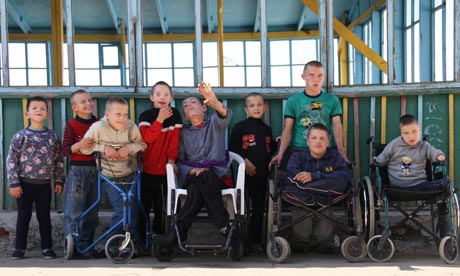
Boys at one of the better institutions … Ukraine's Forgotten Children. Photograph: Matt Teavee/BBC3

Wasted, wax-coloured little bundles of twisted limbs lie, day after day after day, in cots. Huge eyes stare – unbearably unreproachfully – from tiny, emaciated faces. The children who aren't bedridden rock back and forth on sofas and by windows for lack of anything better to do. And this, film-maker Kate Blewett notes, is one of Ukraine's better institutions. The owner, Nikolai Slavov, and his skeleton staff are caring as best they can for their charges but are bedevilled by lack of funds, their country's lack of infrastructure and a government that seems to care nothing for the children's plight.

When Blewett and one of Slavov's staff visit one of the children in hospital – they are taking food and nappies because everything must be provided for patients – it is not the smell of an over-full diaper that greets them, but the smell of a child's flesh rotting. When Blewett questions the doctor, he tells her: "There are many other children like this. You have only seen one." The words are cruel, but his voice has the timbre of desperation. What can you do with a pint of resources and an ocean of suffering?

Ukraine's Forgotten Children (BBC4) was an examination of the legacy of the communist system whereby the parents of disabled children were allowed – encouraged, expected even – to hand over their offspring to the state, which, it was deemed, was better able to care for the children than they were. Though Ukraine gained independence from the Soviet Union in 1991, the practice continues. And, as the number of adults turning to drink and drugs in the country increases (along with the spread of HIV and Aids), so is the number of "social orphans". Their parents live, but have no rights and, for the most part, never visit.

What can you say about such a film except that – as with Blewett's previous films The Dying Rooms (in 1996, about the fates of unwanted children in communist China) or Bulgaria's Abandoned Children (about the inhabitants of a special care home there) – if you saw it, you will never forget it and if you didn't, paltry words on a page will never convey even half the horror.

If the children survive into adulthood – and not the least of the dreadful details in the film was that every institution has its own cemetery – they go into adult, psychiatric or geriatric homes, where they are more often than not drugged into stupor or used as slave labour for life. If they are designated "incapacitated" – which can happen without them ever being personally examined by a medical worker or any other kind of official – they have no rights and no possibility of leaving.

Through an amazing woman called Tatyana Makarava, Blewett meets – secretly, in a field outside their group home – Lyonya and Slava, two "incapacitated" inmates. Lyonya talks of punishment beatings, forcible injections of drugs that "twist your body inside out" and even murders, but it is the look of terror on Slava's face when word reaches them that the home's owner has found out what they are doing that speaks loudest.

She also meets 30-year-old "incapacitated" Boris, who after 24years of institutionalisation – during which he was raped, drugged and forced to carry out and bury the home's dead (interring an estimated 150 corpses in one two-year span) – was rescued by one of his care workers ("God bless her for offering her hand to me") and now lives with her and her family. He talks calmly and lucidly about this suffering, his eloquence as powerful a rebuttal of his diagnosis as his words are condemnation of the system.

It is almost unbearable to watch. How she finds the courage to seek out and stare into the face of such suffering long enough to film it, I do not know. Nor do I know where she finds the wisdom and mastery of herself then to tread the line between shocking us so much that we are compelled to attend but not – not quite – so awful that we must look away. Or how she assembles something that grapples with and informs us comprehensibly about the wider social and political issues, rather than dissolving into one long, screaming howl of pain.

But she has foregone any such personal indulgence and produced something powerful instead of merely emotive. The Dying Rooms caused an international outcry about the terrible things it uncovered. It can only be hoped that Ukraine's Forgotten Children will do the same. There are 80,000 of them out there, waiting for the world to change.

Haiti - Social : UNICEF congratulates and encourages
the Haitian State for its determination
17/06/2012
11:24:03
Haiti - Social : UNICEF congratulates and encourages the Haitian State for its determination

The

Week of the Child ended on an encouraging note for the rights of children in

USAID Ethiopia

⬤ public

USAID’s Displaced Children and Orphans Fund

MONITORING VISIT: ETHIOPIA
February 6 -17, 2012

Istoria tranzi?iei de la "lag?rele de copii" la problemele de ast?zi - GALERIE FOTO

Deficitul de personal, lipsa calific?rii sau fondurile insuficiente sunt probleme cu care se confrunt? sistemul de protec?ie a copilului dup? 15 ani de func?ionare a DGASPC, îns? neajunsurile de azi ?i "lag?rele" în care erau crescu?i copiii cu ani în urm? nu suport? termen de compara?ie.

Istoria tranzi?iei de la "lag?rele de copii" la problemele de ast?zi (Imagine: Funda?ia Sera România)

În iunie 1997, în Prahova, se înfiin?a prima direc?ie pentru protec?ia copilului. Un an mai târziu, fiecare jude? al ??rii ?i fiecare sector al Capitalei aveau o astfel de institu?ie, creat? s? vegheze interesele copiilor în general, vie?ile celor institu?ionaliza?i în mod special.

GALERIE FOTO

Imediat dup? c?derea comunismului, România a devenit celebr? în întrega lume pentru felul în care î?i trata copiii. Imagini cu "lag?rele de copii" au circulat cu repeziciune ?i au atras aten?ia întregii lumi asupra condi?iilor inumane în care cei mici, r?ma?i în grija statului, erau l?sa?i s? moar?.

"Orfanii români, copiii de care nu îi pas? nim?nui", "Copii instrui?i s? cer?easc? ?i trimi?i în Italia ?i Spania, prostituate minore oferite turi?tilor în moteluri, nou-n?scu?i vîndu?i în Ocident", "Copii ra?i în cap, care fac baie în urin? ?i se leag?n? ore întregi pentru a adormi", sunt doar câteva dintre aprecierile f?cute la vremea respectiv? în presa interna?ional?.

Protec?ia copilului a devenit în scurt timp condi?ie pentru integrarea în UE, iar m?surile nu au mai putut fi întârziate. Înfiin?area unor institu?ii care s? "guverneze" acest domeniu a fost un prim pas în ceea ce a însemnat schimbarea condi?iilor de via?? a celor mici ?i a mentalit??ii adul?ilor care îi îngrijeau.

Direc?ia pentru Protec?ia Copilului din Ministerul Muncii precizeaz? c? în iunie 1997, când a început reforma în domeniul protec?iei drepturilor copilului, existau 287 de institu?ii, dintre care 207 case de copii, 22 de case de copii cu alte servicii ?i 58 de leag?ne.

În perioada 2000 - 2001, au fost preluate în sistemul de protec?ie a copilului 250 de institu?ii (29 de protec?ie special? a copiilor cu handicap, 39 de unit??i sau sec?ii de spital ?i 182 de unit??i care îngrijesc copii în regim reziden?ial ?i care func?ioneaz? în cadrul unit??ilor de înv???mânt special), toate fiind reorganizate în cadrul serviciilor publice specializate.

"Urmare aplic?rii politicii de dezinstitu?ionalizare a copiilor, fie prin reintegrarea lor în familia natural? sau extins?, fie prin înlocuirea m?surii de protec?ie de tip reziden?ial cu una de tip familial, s-a ajuns în prezent la 1.201 servicii de tip reziden?ial, din care numai 183 centre de plasament. Într-un deceniu ?i jum?tate, sistemul protec?iei copilului s-a transformat dintr-un sistem închis ?i ignorant fa?? de nevoile reale ale copiilor într-unul flexibil, modern ?i în concordan?? cu normele ?i principiile statuate pe plan interna?ional, România fiind ast?zi în pozi?ia de a reprezenta un exemplu de bun? practic? pentru alte state europene", precizeaz? direc?ia de specialitate din cadrul MMFPS.

Dup? 15 ani de la începerea reformei în protec?ia copilului, Gabriela Coman, fost secretar de stat la Autoritatea Na?ional? pentru Protec?ia Copilului, î?i aminte?te c? adev?ratul început al reformei a fost în 1997, pân? în acel moment neexistând o organizare institu?ional?.

"Ministerele î?i puneau amprenta în îngrijirea copilului educa?ional sau medicalizat. La nivel de teritoriu nu exista niciun serviciu specializat. Din 1995 au existat ONG-uri, precum Sera România, care au pus bazele primelor servicii specializate la nivel de jude?e. Pe scheletul acestora, în 1997 a venit Ordonan?a care a pus bazele unui sistem institu?ional, printre care direc?iile erau cele mai importante. Ele s-au dezvoltat ca singura institu?ie cu aceste atribu?ii ?i ca singurul ?i cel mai mare furnizor de servicii destinate copilului ?i familiei", spune fostul secretar de stat.

Gabriela Coman recunoa?te c? de-a lungul celor 15 ani "au fost urcu?uri ?i coborâ?uri", din cauza faptului c? transferul de atribu?ii nu a fost completat ?i de transfer financiar.

În opinia sa, Direc?iile Generale de Asisten?? Social? ?i Protec?ia Copilului (DGASPC) s-au dezvoltat beneficiind de aportul organiza?iilor neguvernamentale care le-au fost partenere în crearea de centre de plasament sau pentru copii cu handicap.

"Direc?iile ?i-au f?cut treaba de-a lungul timpului. A venit momentul 2001 - 2004, când protec?ia copilului a constituit punct de interes pentru UE ?i a fost un puseu de interes c?tre aceste direc?ii, puseu de fonduri UE pentru direc?ii, proiecte importante ca bani pentru închiderea institu?iilor mari ?i crearea de servicii alternative. Este adev?rat c? presiunea interesului privind închiderea de institu?ii nu a fost întotdeaua rezultatul cel mai bun pentru cazuri concrete de copii. Viteza ?i interesul de închidere a institu?iilor nu a coincis cu o evaluare corect? în fiecare caz în parte", spune fostul secretar de stat.

Din punctul s?u de vedere, în prezent, r?mâne problema personalului, care a fost fluctuant, sistemul confruntându-se acum cu un deficit numeric dar ?i de competen??.

"E greu de f?cut compara?ie cu ce era atunci. Atunci nu aveam nici m?car o construc?ie institu?ional?. Acum sunt actori institu?ionali bine defini?i, prestatori de servicii (DGASPC) ?i o mul?ime de servicii alternative pentru copil", mai spune Gabriela Coman.

Bogdan Panait, secretar de stat la Autoritatea Na?ional? pentru Protec?ia Copilului în perioada 2005 - 2007, spune c? reforma din protec?ia copilului a fost prima în domeniul institu?iilor publice ?i a adus elemente de inspira?ie pentru toate celelalte institu?ii. În opinia sa, ele au ap?rut din necesitatea ca serviciile oferite s? se apropie cât mai mult de copii ?i s? se g?seasc? solu?ii unitare ?i servicii multiple pentru nevoile lor, direc?iile oferind în prezent o protec?ie multidisciplinar?.

"Nu a fost u?or, pentru c? au fost multe jude?e reticente ?i, de?i a început în 1997, reforma a fost finalizat? abia în anul 2000, la cererea Uniunii Europene, deci putem spune c? aceast? reform? a durat foarte mult, comparativ cu alte ??ri în care acest lucru s-a realizat în câteva zile, cum ar fi Ungaria. Cred c? direc?iile ?i-au ar?tat calit??ile prin serviciile mult mai diversificate pe care le ofer?. În perioada 1997 - 2004 au fost înfiin?ate foarte multe servicii, iar progresele au fost vizibile ?i recunoscute ?i pe plan interna?ional", precizeaz? Panait.

Din punctul s?u de vedere, exist? ?i aspecte negative, în sensul c? reforma sistemului nu a inclus ?i o reform? privind preg?tirea personalului, ?i acest lucru s-a v?zut de-a lungul timpului.

Un alt aspect negativ semnalat de Bogdan Panait se refer? la num?rul de copii din sistem, care, în ciuda tuturor schimb?rilor, a r?mas aproape acela?i.

"Din acest punct de vedere, nu a fost foarte eficient. ?i perioada de ?edere în sistem este înc? foarte lung?, în medie de vreo ?ase ani. Se pierde leg?tura cu familia", adaug? Panait, amintind ?i de dificult??ile care apar inclusiv în momentul în care copilul a ajuns la maturitate ?i trebuie s? p?r?seasc? sistemul.

Importan?a func?ion?rii DGASPC-urilor este recunoscut? ?i de c?tre organiza?iile neguvernamentale din domeniu.

"Activitatea Asocia?iei Telefonul Copilului este strâns legat? de cea a Direc?iilor Generale de Asisten?? Social? ?i Protec?ia Copilului înc? din anul 2001. Am gestionat împreun? 37.810 cazuri de înc?lcare a drepturilor copilului, cu prec?dere în ultimii ani, afecta?i de fenomenul crizei financiare ?i apreciem eficien?a interven?iei, cu atât mai mult cu cât aceast? institu?ie a suferit restructur?ri majore tocmai atunci când aveam mai mult ca oricând nevoie de ea", declar? directorul executiv de la Telefonul Copilului, C?t?lina Florea.

În opinia sa, DGASPC este institu?ia care a avut ?i are multe de spus în asisten?a social?, apreciind c? extinderea capacit??ii umane ?i logistice a acesteia este vital? atât în mediul urban, cât ?i în rural.

"Existen?a asisten?ilor sociali, nu a lucr?torilor sociali, în mediul rural ar reprezenta un sprijin real nu numai pentru comunitate, ci ?i pentru personalul DGASPC", spune C?t?lina Florea.

Bogdan Simion, pre?edintele Funda?iei Sera România dar ?i al Federa?iei Organiza?iilor Neguvernamentale pentru Copil, a explicat c? direc?iile au fost create ca organisme specializate ale Consiliilor Jude?ene cu scopul de a reforma ?i dezvolta domeniul protec?iei copilului.

"Mul?i ani, direc?iile au fost cele mai ofensive servicii specializate ale statului în reforma sistemului de protec?ie a copilului, contribuind astfel, al?turi de ONG-uri, la îndeplinirea criteriului politic impus de Uniunea European? referitor la rezolvarea situa?iei copiilor institu?ionaliza?i. Create ca ?i servicii tehnice, profesioniste, apolitice, dedicate copilului ?i familiei, au suferit prima «politizare» la începutul anilor 2000, când au fost trecute în subordinea pre?edin?ilor de Consilii Jude?ene, considerându-se c? influen?a acestor ale?i va fi benefic? sistemului", spune Bogdan Simion.

În opinia sa, influen?a CJ a fost benefic? doar în unele cazuri, de cele mai multe ori direc?iile au fost considerate de prioritate secundar?, beneficiind de resurse din ce în ce mai mici.

"Criza economic? început? în 2008, lipsa de perspectiv? a problematicii sociale a Guvernului în aceea?i perioad?, precum ?i lipsa în?elegerii ?i a strategiei unui minister învechit - Ministerul Muncii - au f?cut ca, pe fondul unui dezinteres politic general, constituit dup? aderarea la Uniunea European?, sistemul de protec?ie a copilului s? regreseze vizibil în ultimii patru ani. În 2012, la 15 ani de la creare, Direc?iile de Protec?ia Copilului încep s? se destructureze, au o lips? acut? de personal (cel pu?in 1/3 din posturile necesare sunt neocupate sau defiin?ate), sunt reactive fa?? de orice fel de probleme ale copiilor, nu mai au niciun fel de coordonare na?ional?, sunt neadecvate fa?? de problematic? ?i, din cauza m?surilor haotice luate de Ministerul Muncii, în unele cazuri au devenit nocive chiar pentru copiii pe care ar trebui s? îi protejeze", consider? pre?edintele FONPC.

Bogdan Simion atrage îns? aten?ia c? DGASPC-urile beneficiaz? de o experien?? inestimabil? în domeniu, reprezint? comunitatea local? din care provin copiii ?i ar trebui revigorate ?i utilizate pentru a continua ce s-a început în urm? cu 15 ani.

Despre o regresie a sistemului de protec?ie a copilului în ultimii ani vorbe?te ?i directorul Direc?iei Generale de Asisten?? Social? ?i Protec?ia Copilului Sector 1, D?nu? Fleac?.

"Ultimii trei ani au însemnat o pr?bu?ire a sistemului. (...) Oamenii care lucreaz? în sistem sunt desconsidera?i. Cel mai mare regret al meu este c? pentru personal nu s-a f?cut nimic", spune D?nu? Fleac?, care coordoneaz? de zece DGASPC Sector 1.

El precizeaz? îns? c? a fost nevoie de DGASPC-uri, pentru c? fostele case de copii din subordinea Ministerului Educa?iei ?i leag?nele din subordinea Ministerului S?n?t??ii trebuiau restructurate.

"Ce se întâmpla acolo a fost la nivel de «valea plângerii». Numai la leag?nul «Sfânta Ecaterina» erau 450 de copii. Sistemul reziden?ial cu sute de copii a fost o tragdie. Clar a fost nevoie de o astfel de organizare ?i, în primii ?ase, ?apte ani, to?i colegii ?i-au f?cut temele", consider? D?nu? Fleac?.

Din punctul s?u de vedere, demedicalizarea sistemului ?i faptul c? au oferit alternative viabile, de tip familial, pentru copii ?i un anumit tip de afectivitate sunt principalele reu?ite ale reformei.

"Chiar dac? nu era afectivitatea p?rin?ilor, era altceva. A fost o alt? calitate a serviciilor. În mod clar au fost alte standarde de calitate. Putem spune c? sistemul de asisten?? social? este singurul sistem cu descentralizare real?. (...) Evolu?ia este colosal?. Nu ?tiu dac? la nivel european exist? vreun stat care s? fi f?cut eforturile României. Sunt probleme pentru c? niciodat? nu ai bani destui. Dar realizarea la nivel na?ional cred c? este unic? în Europa", mai spune directorul DGASPC Sector 1.

De?i diferen?ele sunt uria?e, imaginile fostelor case de copii nu pot fi ?terse nici m?car dup? un deceniu de normalitate. De?i au trecut 15 ani de când direc?iile generale de asisten?? social? ?i protec?ia copilului func?ioneaz?, de?i lucrurile s-au schimbat radical în acest timp, înc? este greu chiar ?i pentru oamenii din sistem s? î?i aminteasc? de condi?iile trecute, de teama de a nu redeschide un subiect care pare s? nu se mai termine.

(Material realizat de Aurelia Alexa, aurelia.alexa@mediafax.ro)


Opschorten adoptieverdrag Uganda goed signaal

14-06-2012 20:45

Nederland schort het adoptieverdrag met Uganda op, zo werd maandag bekend. Dit krachtige signaal is dringend nodig, weet Nico van den Berge uit eigen ervaring.

Een maand of acht geleden besloten mijn vrouw en ik om kinderen uit Uganda te adopteren, het land waar we zelf ook wonen. We meldden ons aan bij een als goed bekendstaand weeshuis. Dit weeshuis had merkbaar ervaring in de omgang met westerse adoptie­ouders. De directrice dreunde uit haar hoofd de adoptieprocedure op. Ze verzekerde ons dat het weeshuis alle mogelijke moeite deed om de biologische ouders van de kinderen te vinden, of andere familieleden. Dat is namelijk een voorwaarde bij de adoptieprocedure.

De eerste vraagtekens rezen toen de sociaal werker van het weeshuis op bezoek kwam om te kijken hoe we woonden en om te onderzoeken of wij goede ouders zijn. Het bleek al snel dat ze geen idee had waarmee ze bezig was. Ze stelde enkele simpele vragen: of we lief zouden zijn voor een kind en hoe onze familie in het verre Nederland erover dacht dat we een kind wilden adopteren. Vervolgens schreef ze een rapport met als belangrijkste constatering dat we een doortrek-wc hadden (in veel Ugandese huizen moet je met emmers water werken).


Kate Blewett uncovers the disturbing fate of children in
Ukraine abandoned to state care


Duration: 02:23


In Ukraine state care has become the norm for children with any kind of
disability. Kate Blewett travels to the country to investigate what life is like
for the children who, abandoned by their parents, live and die under the care of
the state. She also meets former inmates who ended up in psychiatric
institutions labelled as ‘incapacitated’. Her findings are shocking and
disturbing.


Available since: Thu 14 Jun 2012


Credits


Reporter

Kate
Blewett


Director

Kate
Blewett


Assistant Producer

Olga
Betko


Camera
Operator

Matt
Teavee


Executive Producer

Brian
Woods


Executive Producer

Clare
Paterson

This clip is from


Ukraine's Forgotten Children


What a lifetime in the care
of the state really means for Ukraine's abandoned children.


First broadcast: 18 Jun
2012

Governments Communicate in Kairi Case But Won’t Reveal Details (UPDATED JUNE 13)
Address from where 3 months old baby Kairi started her journey to the USA

Washington - The United States government on Tuesday told India America Today that Washington was in touch with Delhi, but the US State Department in the same vein refused to confirm if it had received the letters of communication from its Indian counterparts.

In a reply to a question posed by India America Today, the US State Department replied, “We are in touch with the Government of India regarding this case. For further information I refer you to DOJ and DHS.”

Replying to an email question, the Department of Homeland Security stated that they had no additional information they could share about Kairi Shepherd's ordeal.

“We are not aware of any new developments regarding this case,” said Lori Haley, Spokeswoman, Department of Homeland Security, US Immigration and Customs Enforcement (ICE).

Earlier, one of the senior officials in the Indian Ministry of External Affairs had written in an email to Anjali Pawar, Director of Sakhee and Consultant to ACT (against child trafficking), “The Consulate General in San Francisco, under whose consular jurisdiction, the issue lies, has written to the Office of Foreign Missions of the Department of State in California, and the ICE of the Homeland Security Department.”

The US Immigration and Customs Enforcement (ICE) in May confirmed to India America Today that Kairi Shepherd was “not in ICE custody at this time,” but clarified that “Shepherd has a final order of removal.” Virginia Kice, the Western Regional Communications Director/Spokesperson for ICE, replied to India America Today, “Before carrying out a deportation, ICE must first obtain a travel document to ensure the receiving country will admit the alien who is being returned. Once ICE obtains a travel document, the agency then proceeds to make transportation arrangements.”

“Completing the removal process can take varying amounts of time, depending on the country involved and the circumstances of the case,” said Kice.

On the same day, a spokesperson for the Indian Embassy in Washington, DC broke the silence saying, “The Embassy has seen reports concerning Kairi Shepherd, and has requested the US authorities for facts on this matter.”

Citing the humanitarian dimension of the case, “that cannot be ignored,” Virander Paul said in an email, “As reports indicate, Kairi Shepherd was brought to the United States after adoption, as a baby, and has known no other home.”

Without mentioning if the embassy had received a request from the US for travel documents for Shepherd, Paul said, “Her case deserves to be treated with the utmost sensitivity and compassion, keeping in mind the humanitarian dimension and tenets of universally accepted human rights.”

ICE gave India America Today a detailed account of the Shepherd case saying, “Shepherd was originally encountered by US Immigration and Customs Enforcement (ICE) Enforcement and Removal Operations (ERO) officers at the Salt Lake County Adult Detention Complex in October 2007, following her incarceration on unknown local charges. ERO officers processed Ms. Shepherd and placed her in immigration removal proceedings after determining she was potentially deportable based upon her criminal history.”

“An immigration judge with the Department of Justice’s Executive Office of Immigration Review (EOIR) ordered Ms. Shepherd deported in February 2010, and the 10th Circuit Court of Appeals recently declined to take action that would have set aside that order,” ICE stated.

“Background checks indicate Ms. Shepherd’s criminal history includes two prior convictions in Utah in 2004 for attempted forgery and forgery, the latter of which constitutes an aggravated felony,” detailed the ICE statement about Shepherd’s criminal history.

“ICE has reviewed Ms. Shepherd’s case at length and believes seeking her removal is consistent with the agency’s immigration enforcement priorities, which include focusing on the identification and deportation of aliens with felony criminal convictions,” the ICE statement concluded.

The story began on a happy note in 1982 when 3 month old Indian orphan Kairi arrived in the US and was adopted by a Utah woman. Her adoptive mother unfortunately died of cancer when she was only 8 years old and at age 17 (still a minor under US law), Shepherd was arrested and convicted of felony check forgery to support a drug habit. She subsequently served her sentence for the conviction.

Now at the age of 30, Kairi Shepherd faces deportation because Judge Scott Matheson, in a 23-page decision, said the court didn’t have jurisdiction to determine Shepherd’s legal status.

The case is clouded in a maze of technicalities, as the court found there was a failure to file a second appeal through the Board of Immigration Appeals as well as Shepherd attempted to get her petition reviewed prematurely.

The Indian Federal Ministry of Welfare in its guidelines for adoption posted on the Indian Embassy’s (Washington, DC) website (http://www.indianembassy.org/guidelines-for-adoption-of-indian-children.php) outline very specific procedures which must take place in order for an Indian child to be adopted abroad. Questions are being raised regarding whether the procedures are actually followed, as 30 year old Kairi Shepherd faces deportation to a country from which she was uprooted as a 3 month old baby.

Chapter 2 of the “Liaison with Indian Diplomatic Missions,” instructs:

“The Central Adoption Resource Agency shall maintain liaison with Indian diplomatic missions abroad in order to safeguard the interests of children of Indian origin adopted by foreign parents against neglect, maltreatment, exploitation or abuse and to maintain an unobtrusive watch over the welfare and progress of such children.

For this purpose, the Central Adoption Resource Agency shall inform every Indian diplomatic missions concerned whenever an Indian child is taken in adoption or for the purpose of adoption, by foreign parents. The names, addresses and other particulars of such children and their adoptive/prospective adoptive parents shall be supplied to the Indian diplomatic missions as early as possible and in any case before the end of every quarter.”

The chapter states that "Periodical Progress reports of children from foreign adoptive parents as well as from recognized social or child welfare agencies in foreign countries" should be obtained, "to examine such reports and to take such follow-up action as deemed necessary.”

It is unknown whether Periodical Progress reports were obtained in Kairi Shepherd’s case or if CARA followed up after the death of her adoptive mother.

Chapter 6, under “Rights of the Child Taken Abroad,” explicitly notes, “On adoption of the child by the foreign parent according to the law of his/her country, it is presumed that subject to the laws of the land the child would acquire the same status as a natural born child within wedlock with the same rights of inheritance and succession and the same nationality as the foreign parent adopting the child.”

Guidelines penned by a task force of members from voluntary placement agencies under the chairmanship of Justice P.N. Bhagwati (the former Chief Justice of India) declared: “Even after the adoption is legalized, the enlisted foreign agency should maintain contact with the adoptive family in keeping with the need of privacy of the adoptive family and provide support and counseling services, if necessary and safeguard the interest of the child till such time as he/she attains majority.”

It appears the repeatedly orphaned Shepherd was denied her specific “rights of the child taken abroad” from India and that there were widespread failures among the checks and balances designed to protect vulnerable minor children from India who have been adopted abroad.

“She doesn’t have any known family in India, has no contacts, has lost the ability to speak any Indian language and might just die due to her serious health ailment of multiple sclerosis, after being thrown on Indian roads,” declared Pawar, questioning, “Why after her adoption in the US, her citizenship status has not been adjusted?”

“As long children from India adopted by US parents are faced with the threat of deportation, adoptions from India to the US should be halted altogether,” demanded Pawar in her letter to Indian Foreign Minister Krishna. (IATNS)

Spread of 'baby boxes' in Europe alarms United Nations

UN says hatches in which unwanted newborn babies can be left contravene children's rights to know and be cared for by parents

A baby bank in Hamburg, Germany: over 400 children have been abandoned in hatches in Europe since 2000. Photograph: Nina Ruecker/Getty Images

The United Nations is increasingly concerned at the spread in Europe of "baby boxes" where infants can be secretly abandoned by parents, warning that the practice "contravenes the right of the child to be known and cared for by his or her parents", the Guardian has learned.

The UN Committee on the Rights of the Child, which reports on how well governments respect and protect children's human rights, is alarmed at the prevalence of the hatches – usually outside a hospital – which allow unwanted newborns to be left in boxes with an alarm or bell to summon a carer.

The committee, a group of 18 international human rights experts based in Geneva, says that while "foundling wheels" and baby hatches had disappeared from Europe in the last century, almost 200 have been installed across the continent in the past decade in nations as diverse as Germany, Austria, Switzerland, Poland, Czech Republic and Latvia. Since 2000, more than 400 children have been abandoned in the hatches, with faith groups and right-wing politicians spearheading the revival in the controversial practice.

Their proponents draw on the language of the pro-life lobby and claim the baby boxes "protect a child's right to life" and have saved "hundreds of newborns". There are differing opinions on this key social issue across Europe. In France and Holland women have the right to remain anonymous to their babies after giving birth, while in the UK it remains a crime to secretly abandon a child.

However UN officials argue that baby hatches violate key parts of the Convention on the Rights of the Child (UNCRC) which says children must be able to identify their parents and even if separated from them the state has a "duty to respect the child's right to maintain personal relations with his or her parent".

In an interview with the Guardian, Maria Herczog, a member of the UNCRC committee, said that the arguments from critics were a throwback to the past. "Just like medieval times in many countries we see people claiming that baby boxes prevent infanticide … there is no evidence for this."

Herczog, a prominent child psychologist from Hungary, says baby boxes should be replaced by better state provision of family planning, counselling for women and support for unplanned pregnancies.

She likened the pro-baby box movements in Europe to the religious right in the US. "Very similar to the United States where we have the spread of the Safe Haven programme with baby boxes in 50 states since 1999. Now we have MEPs arguing for baby boxes and they just reject the convention."

The committee wrote last year to the government in the Czech republic, which has seen 44 baby boxes set up since 2005, asking it "undertake all measures necessary to end the programme as soon as possible".

The ensuing row spilt over borders with two dozen right-wing MEPs, including the current president of Hungary, writing to complain that baby boxes "offer(ed) a solution for women who unfortunately keep their pregnancy a secret and fear to approach official instructions".

In an email to the Guardian, Manfred Weber, German MEP and vice-chairman of the European People's Party – the largest grouping on the centre right – who signed the anti-UNCRC letter, said the issue was one of competing "rights". "Although I am convinced that a child is best raised within an intact family, the safety of children is of higher priority than their desire to know their biological parents," he said.

There is evidence that the baby box idea is popular. A Swiss poll in 2011 found 87% saying baby boxes were "very useful or useful" and more than a quarter of respondents thought every hospital should have one.

Herczog said that the committee is undeterred. "We review countries' adherence to the convention. We did Czech Republic. Austria is coming up. I cannot say for sure but I can imagine we will do the same for Austria (as the Czech Republic)".

Her stance was backed by experts. Kevin Browne of the Centre for Forensic and Family Psychology at The University of Nottingham has just completed a two-year study into the phenomenon. He said of the 27 EU member countries, 11 still have "baby hatches" operating – Austria, Belgium, Czech Republic, Germany, Hungary, Italy, Latvia, Lithuania, Poland, Portugal and Slovakia.

"There is growing evidence that it is frequently men or relatives abandoning the child, raising questions about the mother's whereabouts and whether she has consented to giving up her baby," he said. "You also have to ask whether an anonymous drop allows the authorities to check whether there's a chance for the baby to remain with its family in the care of other relatives."

Browne's research found that the Czech Republic and Lithuania both have an average of seven infants left in baby hatches per year, followed by Poland with six and Hungary and Slovakia with four – and highlighted that baby boxes had flowered in post-Communist eastern Europe.

Politicians in the former Communist bloc dispute this analysis. Miroslav Mikolášik, a Christian Democrat MEP from Slovakia, said that the "communist idea" was "to take away violently a child from a family that they considered as an enemy of regime and place him or her in a state orphanage … If UN convention on the rights of the child's article 8 that guarantees children's right to know their own identity means the death of only one unwanted baby, it is a very wrong article and very wrong convention."

In western Europe the issue is complicated by religious practice and the law. Sari Essayah, Finnish MEP from the centre-right Christian Democrats, pointed out that in Scandinavia "two lesbians can get sperm anonymously and have children. They don't know the name of the donor. So what about the rights of the child? The UN have got it wrong here about baby boxes."

Perhaps the most taxing problem will be Germany, the powerhouse of Europe, which has about 80 baby boxes operating across the nation. The German constitution says all citizens have a right to "know of their origins" and fathers have a right to be part of a child's upbringing. Both are breached when a mother gives birth anonymously. Hatches are tolerated – but earlier this year German ministers floated the possibility of a new "legal framework for confidential births".

In February the German Youth Institute found that the anonymous service had lost trace of a fifth of all abandoned babies – giving ammunition to those who want to end the practice.

However Bernd Posselt, Christian Social Union MEP for Munich who signed the letter to the UNCRC last year, told the Guardian that "our experiences with baby-boxes here in Munich, for example organised by a monastery, have been positive. I know also the problems, but for me it is essential to protect and to safeguard the life of children in extreme situations. All other problems can be solved with good will as long as the child is alive. It is not the decision of an United Nations committee what we are doing to help born or unborn children".

hildren need families not institutions! - ending the harmful institutionalisation of children in Europe.

Date

06 Jun 2012 16:00

Address

European Parliament
  Brussels
Belgium

Event Type

M - Seminar, presentation

Organiser type

Federations / Associations

Section

Social Europe & Jobs

Event Location

Brussels

Event Description

Exhibition and Expert Roundtable hosted by Mairead McGuinness, MEP
Date: 06 June 2012
Venue: ASP Ground floor. Exhibition space outside the Members restaurant
Time: 16:00 – 18:00
Overview:
This unique and powerful exhibition will highlight that for over a million children in Europe, the right to a family life is still not realised. Visitors will hear from young people themselves and from experts in child development and fundamental rights about the detrimental effects of institutionalisation, and the benefits of prevention and alternative care. In a Europe of rights, no child should have to grow up in and institution; with policy support and funding from the EU, they won’t have to. Speakers at the roundtable include Dr Charles H. Zeanah, a leading global expert in early childhood development, and renowned children’s rights expert Dr Maria Herzog of the UN’s Committee for the Rights of the Child. Speakers include Commissioner László Andor and Vice-President of the European Parliament Roberta Angelilli.
Registration:  You can register to attend the vernissage at  http://ark-exhibition.eventbrite.com/