International Adoption Halted for First Time in 70 Years… Zero Children to Be Adopted Overseas by 2029
South Korea, once branded a "child exporting nation," is suspending international adoption for the first time in 70 years. The move signifies the state's intention to take full responsibility for these children, given the widespread human rights violations that occurred during the adoption process. However, concerns are being raised that this may remain merely a declaration without concrete implementation plans, as this is not the first time the government has announced a suspension and the plan is to pursue a phased discontinuation over a set period. Critics have also pointed out that measures supporting domestic adoption and child-rearing within the birth family, such as support for unmarried mothers, must be implemented alongside the suspension.
On the 26th, the Ministry of Health and Welfare announced the 3rd Basic Plan for Child Policy, which contains these details. The Basic Plan for Child Policy is a mid-to-long-term national plan established every five years in accordance with the Child Welfare Act, serving as a blueprint outlining the direction of child policy for the next five years. During a press briefing on the same day, First Vice Minister Lee Se-ran stated, "We will stably establish a public adoption system and gradually discontinue international adoption." Regarding the specific timeline, she explained, "We intend to discontinue it within two or three years, and our goal is to reach zero cases by 2029 at the latest." 24 children were adopted overseas this year .
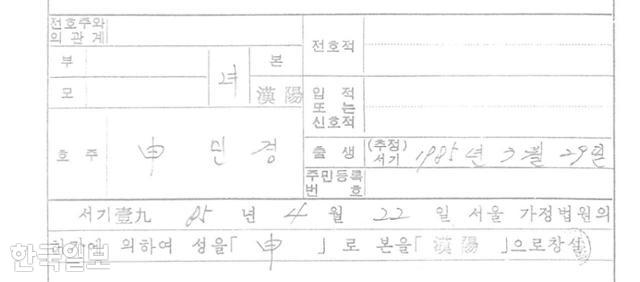
Content regarding the creation of a new clan name, 'Hanyang Shin,' for an adoptee in 1985 to send a newborn baby overseas. Courtesy of the Solidarity of Overseas Adoptees.
Korean overseas adoption, which began in the 1950s, has been plagued by continuous controversy regarding human rights violations. Since the relinquishment of parental rights was a prerequisite for overseas adoption, adoption agencies sometimes arbitrarily created "orphan family registers." Furthermore, it was common for dozens of children to be loaded onto airplanes like cargo and sent abroad all at once. There have also been testimonies that some children died during this process. The system in which adoption agencies collected fees amounting to tens of millions of won per child has also been pointed out as a problem. In the United States, children could only acquire citizenship if their parents went through the adoption process; it is estimated that approximately 40,000 adoptees are living at risk of deportation because they failed to do so. To date, the number of people sent overseas for adoption through these processes amounts to about 200,000.
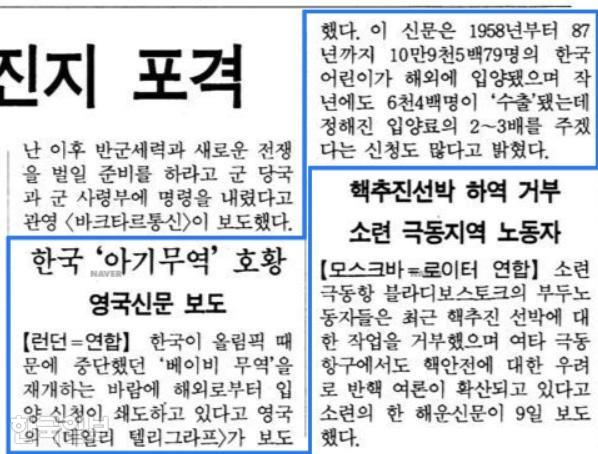
A Kyunghyang Shinmun article from February 10, 1989, titled 'Korea's Baby Trade Boom'. Naver News Library
Related Articles
• "Korea Ruined My Life": At Least 40,000 Korean Adoptees Without U.S. Citizenship [People Who Exist But Do Not, Stateless]
( www.hankookilbo.com / News / Read / A2021102515130005937 )
As time passed, adoptees grew up and began returning to Korea, and the international community, including the United Nations and "recipient countries" that had previously adopted Korean children, such as Denmark and Belgium, also began to pay attention to the human rights violations in Korea, which was once called the "world's largest baby exporter." Until this declaration, Korea remained the only country among OECD member nations that sent children for overseas adoption.
![Overseas adoptee Kim Yu-ri is kneeling before Chairperson Park Sun-young and pleading for the truth to be revealed during a press conference held on March 26 at the Namsan Square Building in Jung-gu, Seoul, to announce the Truth and Reconciliation Commission's decision on the truth-finding of human rights violations during the overseas adoption process. The Truth and Reconciliation Commission [applicant]](https://imgnews.pstatic.net/image/469/2025/12/26/0000905213_004_20251227061113414.jpg?type=w860)
Overseas adoptee Kim Yu-ri kneels before Chairperson Park Sun-young and pleads for the truth to be revealed during a press conference held on March 26 at the Namsan Square Building in Jung-gu, Seoul, to announce the Truth and Reconciliation Commission's decision on human rights violations during the overseas adoption process. The Truth and Reconciliation Commission classified only 56 out of 367 applicant cases as human rights violations and recommended an official apology from the state. News1
The South Korean government's belated changes only began this year. Last March, the Truth and Reconciliation Commission recognized 56 of the investigation requests filed by these individuals as victims of serious human rights violations. This marked the first time the government officially acknowledged responsibility for human rights violations throughout the entire process of overseas adoption. Subsequently, last October, the country ratified the 'Convention on the Protection of the Child and Cooperation in International Adoption' (The Hague Convention on International Adoption), thereby gaining the status of a party. The transition to a public adoption system, in which the government takes responsibility for the entire adoption process previously entrusted to private adoption agencies, is a measure taken in accordance with this convention.
Related Articles
• "If you die, we will give you the baby instead"... Danish adoptees request Truth and Reconciliation Commission to investigate 'human rights violations'
( www.hankookilbo.com / News / Read / A2022082115450003296 )
While the government's declaration to suspend overseas adoption is certainly significant in itself, it may end up remaining merely a declaration without concrete details to back it up. In fact, this is not the first time Korea has declared a suspension of overseas adoption. In 1990, the Ministry of Foreign Affairs stated during a parliamentary audit on November 28 that it would "completely halt the overseas adoption of orphans starting in 1996," but the promise was not kept. Similarly, on July 26, 1997, the Ministry of Health and Welfare announced, "We aim to completely halt the overseas adoption of our children around 2015 by reducing the scale of approvals by 3–5% annually," but the result was the same. Former Minister of Health and Welfare Kim Keun-tae also stated during a 2005 parliamentary audit that he would "abolish overseas adoption in four or five years," but this promise was not kept.
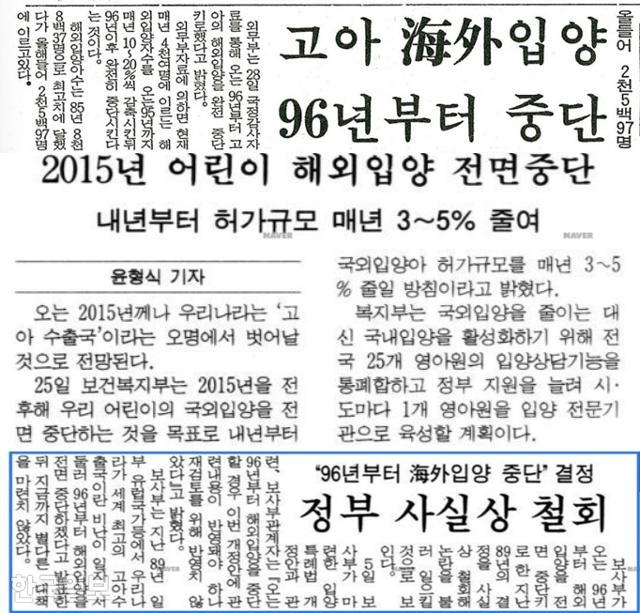
Article regarding the South Korean government's past declaration to suspend overseas adoption. Naver News Library
In particular, the current government maintains that a complete halt is impossible, as there are cases where children are adopted overseas because they cannot find adoptive families domestically. A Ministry of Health and Welfare official stated at a press briefing on the same day, "We have not yet included a plan to immediately stop overseas adoption because there are instances where experts (adoption reviewers) may determine that overseas adoption is better than domestic protection." However, they did not provide a specific answer regarding what specific cases would be deemed better.
Nevertheless, voices from the field suggest that the number of parents waiting for adoption domestically exceeds the number of children eligible for adoption. This implies that if the government has a strong will, the timing for suspending overseas adoption could be brought forward. Jeong On-ju (51), a "senior parent" who has adopted two children and has been conducting pre-adoption parent education, said, "As of this year, there are about 200 children waiting for adoption, but the number of people who newly received pre-adoption parent education this year alone amounts to 350." She added, "Since adoption agencies did not accept adoption applications last year ahead of the reform of the public adoption system, the actual number of parents who want to adopt is likely even higher." Although there is a misconception that there are many cases of children with disabilities being adopted overseas, the Ministry of Health and Welfare explained in a press briefing following the President's work report on the 16th that "statistics on disabled children among overseas adopted children are not compiled separately, and only statistics on children with health issues are managed."
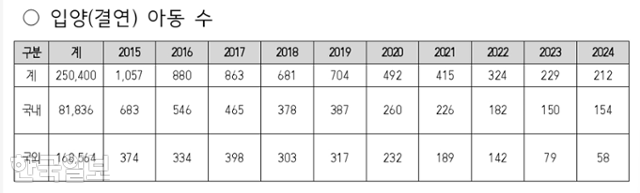
Annual number of domestic and overseas adoptions (as of December 2024). Office of Rep. Kim Ye-ji, People Power Party
There are also calls for policies supporting domestic adoption and child-rearing within the birth family to be implemented in parallel, considering the intent of reforming the public adoption system for child protection and ratifying the Hague Convention on International Adoption. Jeong stated, "Parents awaiting adoption find the long waiting periods and complex procedures the most difficult. Improvements to related systems are necessary." It is also pointed out that there are still significant blind spots in support for unmarried mothers. Kim Min-jeong, representative of the Unmarried Mothers' Family Association, said, "The time when unmarried mothers most frequently decide to give up their child is during pregnancy." She added, "Many unmarried mothers confide that they cannot eat because they have no rice even though they are seven months pregnant, or that it has become difficult to find even part-time work because their bellies are too big. If support is provided during pregnancy, the instances of giving up the child will decrease."