Allegations of missing babies still haunt Serbia.
Criminal markets often treat human beings as commodities. Victims of human trafficking are bought and sold mainly for forced labour or sex, while migrants are smuggled for a price, sometimes under conditions that cost them their lives. There is even a black market for babies.
Over the past 70 years, as many as 10 000 babies have allegedly disappeared from maternity hospitals across Serbia under questionable circumstances.1
After months of investigation, which covered several ministries, local self-government authorities and health care and other institutions, the Serbian Ombudsman identified a number of omissions in the work of competent public authorities and institutions vested with public powers, which are listed in the relevant sections of the Report of the Protector of Citizens on the So-called “Missing Babies” Cases with Recommendations, Protector of Citizens, Belgrade, 29 July 2010, https://www.ombudsman.org.rs/attachments/article/117/Missing%20babies%20cases%20report%20-%20Serbian%20ombudsman.doc. Close footnote
The story is always the same: parents are told that their child died after birth, but they were neither allowed to see the child’s body nor told where it was buried. As one mother testified in 2018 about her 1988 case, ‘a doctor came to me and told me … that my baby was dead. They said it was better not to see the dead child because I would remember that image for the rest of my life.’2
Adriana Jankovic, ‘Idi kući, rađaćeš još Potresne ispovesti roditelja koji sumnjaju da su im deca ukradena u porodilištu, Blic, 12 February 2018, https://www.blic.rs/vesti/drustvo/idi-kuci-radjaces-jos-potresne-ispovesti-roditelja-koji-sumnjaju-da-su-im-deca/ls1hl1f. Close footnote
Babies started to disappear during the communist period in the former Yugoslavia. At the time, many parents could not fathom the lack of information concerning the death of their child. But under communism, people did not question official narratives.3
Missing Babies, Off The Grid, TRT World, 18 February 2020, https://www.youtube.com/watch?v=KXDPx7YFWnk. Close footnote
As one mother observed, ‘at that time, in that system, any woman who tried to condemn a doctor and dispute such a sudden death of her child would be declared insane’.4
For many years, the disappearance of babies from maternity wards in Serbia was an open secret.5 But this situation changed in 2013 when the mother of a missing baby, Zorica Jovanović, won a case against Serbia before the European Court of Human Rights.6 The case had been filed with the Court after Serbian authorities had continuously denied Jovanović access to information about the fate of her son, who had allegedly died in 1983 while in the care of a state-run hospital. The case focused on Article 8 of the European Convention on Human Rights, which provides a right to respect one’s private and family life. Jovanović was awarded €10 000 in non-pecuniary damages due to the court’s finding that Serbia had failed to provide her with credible information as to the fate of her son. She has never been given his body or informed about where he is allegedly buried. In addition, his death was never properly investigated or even officially recorded. The court also ordered Serbia to take all appropriate measures to establish a mechanism aimed at providing individual redress to all parents in a similar situation.
It took Serbia until 2020 to pass legislation on the missing babies.7
Officially, it is called the Law on Determining the Facts on the Status of Newborn Children Suspected of being Missing from Maternity Hospitals in the Republic of Serbia. Close footnote
The government established a commission to gather facts on the status of all newborn babies suspected of having gone missing from maternity hospitals in Serbia and to provide up to €10 000 in compensation to the parents. At that time, many people testified publicly about their cases. One mother recalled how she was haunted by the thought that someone could bury a child without the parents’ knowledge, and decided to report her case once Serbia adopted the law.
Thus far, a total of 694 applicants (mostly from Belgrade) have filed motions to begin proceedings to determine the fate of newborn babies believed to have disappeared from one of the country’s maternity wards.8
Zorica Jovanović v. Serbia, Application no. 21794/08, ECHR, 9 September 2013, Status of execution, https://hudoc.exec.coe.int/ENG?i=004-7011 . Close footnote
Ana Stamenić, a judge in the Special Unit of the Higher Court for the Suppression of Corruption in Novi Sad, noted in July 2021 that although one case had been resolved, another 99 cases were still pending.9
U novosadskom sudu navala je sudskih sporova o nestalim bebama, Dnevnik, 8 July 2021, https://www.dnevnik.rs/hronika/u-novosadskom-sudu-najezda-sudskih-predmeta-o-nestalim-bebama-08-07-2021. Close footnote
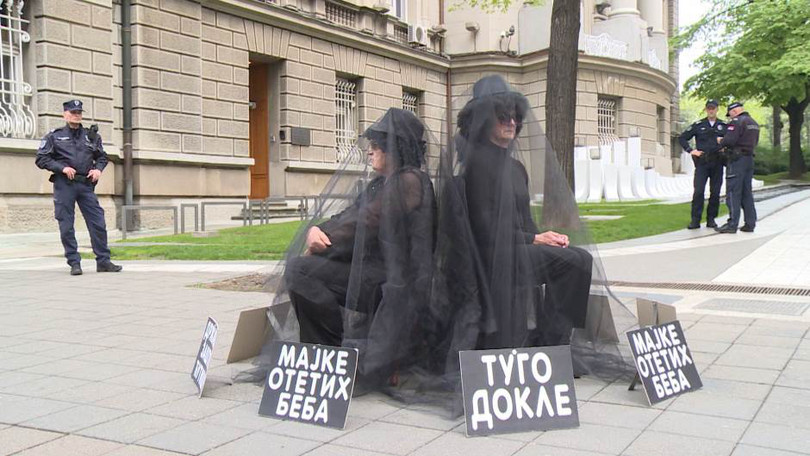
A 2019 protest in Serbia to denounce pending cases of missing babies.
Photo: N1
However, there is increasing hope for resolution of at least some cases. In September 2021, Mlađan Radivojević, after multiple DNA analyses, managed to find his biological family and prove that he was abducted from a hospital in Serbia 40 years ago.10
Ljiljana Raičević, “Sad imam sestru, majku, brata i znam čiji sam” – jedan slučaj otetih beba danas dobio epilog, Radio Television Serbia, 30 September 2021, https://www.rts.rs/page/stories/sr/story/125/drustvo/4533049/bebi-afera-otet-bebe-epilog-sud-krusevac.html. Close footnote
How is the market organized?
While stealing babies is irrefutably a heinous act, can it be considered a type of organized crime? The United Nations Convention against Transnational Organized Crime describes criminal groups as a structured group of three or more people, existing for a period of time
for the purpose of achieving illegal monetary gain.
In Serbia, illegal adoption seems to have been the main modality for stealing babies from their biological parents. In these cases, a non-existent woman is registered on the documents as the mother, after which falsified documents declare that she gives the child up for adoption.
The illegal adoption procedure takes about one week. The process is usually arranged by legal mediation agencies or lawyers that provide buyers with the necessary contacts. For a fee of around US$10 000, which was the price in 1998,13 they fill out the necessary paperwork and arrange the handover, logistics and accommodation.
Testimonies sometimes point to the involvement of state officials in falsifying the child’s documents: state officials are reported to have listed non-existent women as mothers in official documents or created documents in which a mother renounces the baby and gives it up for adoption. Report of the Board of Inquiry Charged with Ascertaining the Truth about New-born Babies Abducted from Maternity Wards in Several Serbian Cities (2005) - A report of a Board of Inquiry formed by the republican parliament with the aim of helping parents who believe that their newborn children have disappeared. In its report, the Board describes the observations it made based on investigations and interviews with a number of parents in private sessions. There were also cases in which funeral companies stated that the supposedly deceased children never reached the cemeteries and had not been buried or cremated.The ‘missing babies’ scandal, European Implementation Network, 5 December 2019, In another incident, it was discovered that the files for 29 babies adopted from 1976 to 1981 disappeared from a Serbian centre for social work.
Doctors have reportedly also been complicit in these schemes. An American woman who adopted a baby from Serbia in 1998 stated that she paid a doctor US$2 800 together with a donation of US$1 000 to a maternity hospital to facilitate the adoption.18 There are also cases in which doctors allegedly mediated the illegal sale of children or signed the child’s birth and death certificate.19 In another example, a letter from a maternity hospital in Novi Sad stated in 2019 that they had 72 stillborn babies that were all sent to a certain cemetery. However, the cemetery declared in 2019 that it had received the bodies of only 15 stillborn babies from that particular hospital.20 Given the pattern of apparent cooperation between lawyers, doctors and state officials, this could be seen as a type of organized crime.
A wider problem
This crime is not unique to Serbia. For instance, from the 1950s to the 1990s in Spain, more than 50 000 babies were reportedly stolen from their mothers.The modus operandi was similar to the one in Serbia: the biological mother was informed that the infant had died shortly after birth, while the newborn baby was actually given up for adoption, often making it appear as if the adoptive parents were the biological parents. Further steps are necessary to stop illegal adoption worldwide. After an official inquiry, in February 2021 the Netherlands suspended all adoptions from abroad. In addition, in August 2021, the United Nations Committee on Enforced Disappearances urged Switzerland to investigate illegal adoptions from Sri Lanka that took place over a period of three decades, beginning in the 1970s. One would hope that with Serbia’s new law and greater attention to this crime at home and abroad, the risk of missing babies would be reduced in the future.
However, a new danger appears to be emerging: a black market for embryos in Serbia and the Balkans. In 2019, police in Greece traced 24 embryo sales.The president of the Association of Missing Babies of Vojvodina has warned parents that Serbia is not immune to this crime. As hard as it is to believe, a market for stolen babies could be supplemented by an emerging market for stolen embryos.