International adoptions, guide for families and diplomats to avoid red tape arrives
An easy-to-consult tool for those facing and following an international adoption to avoid the bureaucracy that too often holds back this path. A tool for all those involved: from citizens to embassy and consulate operators. This is essentially the 'Guide to international adoptions', produced by the Ministry of Foreign Affairs in collaboration with the Presidency of the Council of Ministers' International Adoption Commission, presented on Thursday 15 January at the Farnesina, in the presence of the head of the ministry Antonio Tajani, the Minister of Family, Birth and Equal Opportunities Eugenia Maria Roccella and the vice president of the CAI, Vincenzo Starita. "We want to give a signal to reduce bureaucratic paths," said Tajani, "at least the internal ones. Adopting a child is a gesture of great generosity, but it is not easy. The guide aims to break down the obstacles that prevent adoptions from taking place quickly. Bureaucracy cannot hinder an attempt to do good'.
La presentazione alla Farnesina
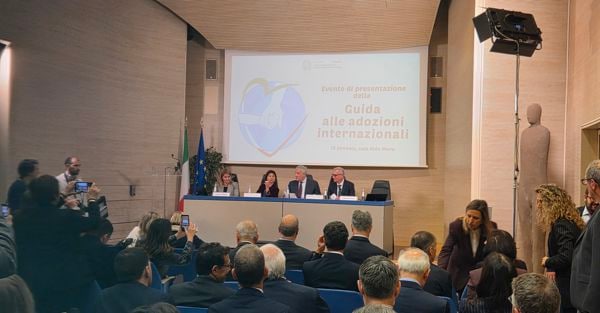
I ministri Antonio Tajani ed Eugenia Maria Roccella, e il vicepresidente della CAI Vincenzo Starita presentano alla Farnesina la “Guida alle adozioni internazionali”.
The document therefore aims to provide simple and effective guidance to all Italian families who decide to embark on this important path. In addition, the Guide provides useful hints to sector bodies and operators of the diplomatic-consular network in order to manage the various administrative procedures in the best interests of the minors involved more quickly and effectively. In fact, it has been sent to all the diplomatic-consular representations and will also be distributed in a printed version to the authorised bodies by the CAI, while remaining available on the Farnesina websit
La guida alle adozioni internazionali della Farnesina
Declining demand for adoptions worldwide and countries' willingness to let children go for adoption
The starting point is the one highlighted by Roccella. "The demand for adoptions in the world is dropping, and so is the willingness of countries to open their borders and allow children to be adopted. The problem of denatality affects everyone, not just us Italians. A country with a population decline that is too pronounced begins to see children as an asset to be kept within its borders. Added to this is a drop in applications, in Italy less than elsewhere'.
The guide reports some figures: in the first six months of 2025, there were 242 international adoptions concluded in Italy, a slight increase over the same period in 2024, when 234 were recorded. The data, updated to 30 June 2025, allow us to outline some positive trends. Comparing the numbers for the first half of 2025 with those of previous years on an annual basis, increases in some countries emerge. A few examples. In Brazil, there were 12 adoptions in the first six months of 2025, compared to 19 for the whole of 2024 and ten in 2023. In Burundi, there were 16 adoptions already completed (more than the 14 for the whole of 2024). In Poland, there were eight adoptions in the first six months of 2025, compared to four in the whole of 2024. In contrast, there is a decline in adoptions from countries traditionally characterised by higher numbers, such as Colombia, the Philippines and Vietnam, and in newly opened countries, such as Sierra Leone (after an encouraging start, they showed a decline). The minister recalled that the government 'has provided 52 million euro' for adoptions, 40 million of which 'for families', plus another 13 million decree published in December with various contributions, such as a 2,800 euro decree for families with procedures initiated in the 2022-2024 period and a 1,000 euro decree 'for the preparatory training course'. In Italy, she recalled, there is also 'a generous willingness on the part of Italians towards children with special needs, the famous special needs'.
The role of the Farnesina
The Ministry of Foreign Affairs and International Cooperation (MAECI) exercises its competence in the field of intercountry adoptions through the Directorate General for Services to Citizens Abroad and Migration Policies (DGIT), in which a Coordinator for Foreign Minors' Policies, a member of the CAI, operates. MAECI coordinates, through the diplomatic-consular network, institutional relations with couples (or individuals) who turn to the Minister and to the Embassies or Consulates to request interventions to resolve situations of difficulty and delays in the conclusion of international adoption procedures. The MAECI is also part of a Technical Table with the CAI, which meets on a quarterly basis, with the task of coordinating reciprocal efforts in the management of intercountry adoptions and planning joint initiatives for the promotion of child protection objectives to be carried out also with the contribution of the Embassies and Consulates.
Foreign minor
The child is at the centre of intercountry adoption and the Hague Convention of 29 May 1993 "On Protection of Children and Co-operation in Respect of Intercountry Adoption" enshrines the need to provide for measures to ensure the protection of the child's best interests and respect for his or her fundamental rights. It recognises that, for the harmonious development of the child's personality, he or she must grow up in a family environment, in a climate of loving happiness and understanding, and stipulates that each State must, as a matter of priority, take appropriate measures to allow the child to remain in the family of origin or in a suitable foster family, resorting to adoption abroad only if this is impossible (the so-called principle of subsidiarity). The Convention, working through a system of National Central Authorities, also aims to protect children and their families against the risks of illegal, irregular or premature adoption and to prevent the abduction, sale or trafficking of children.
Couples (or singles)
Couples (or individuals) wishing to adopt who have obtained a decree of eligibility shall, within one year from the communication of the decree, appoint one of the Bodies authorised by the Intercountry Adoption Commission to operate in the chosen country of origin to take charge of their adoption procedure. The Register of Authorised Bodies is published on the Commission's website www.commissioneadozioni.it.
Authorised Italian institutions
Italian agencies inform, train, and assist prospective adoptive parents in the international adoption process and take care of the procedures necessary to carry out the adoption abroad, assisting them before the foreign authority and supporting them in the post-adoption process.
The authorised agencies, once they have received the foreign authority's proposal to match the child for adoption, inform the adoptive couples and assist them in the process of getting to know the child. If the couple's (or the individual's) meetings with the child are successfully concluded, the competent judicial or administrative authority in the country of origin, having ascertained that an adequate parental bond has been established, issues the adoption order. This order is transmitted by the authorised body to the Intercountry Adoption Commission together with other documents concerning the child, including the birth certificate.
The Tasks of Embassies and Consulates
The Embassy or Consulate receives from the CAI the provision authorising entry and permanent residence in Italy, which is necessary for issuing the entry visa for adoption for the benefit of the adopting child.
The child's travel document
One of the recurrent problems in the conclusion of intercountry adoption procedures is the delay in the issuance of a travel document for the child whose adoption has been authorised by the authorities of the country of origin. In exceptional situations and only in cases where it is possible to identify unequivocally, by means of documents, the foreign adopted child, Embassies and Consulates may resort to issuing a laissez-passer.