Home  

Revealing Ground Zero of the Swiss Adoption Scandal

Switzerland is under scrutiny for fraudulently rehoming thousands of babies. The failures go back further than previously understood


When Paul Harwood, a founding member of the Central Intelligence Agency, relocated to Paris from Vietnam, he was keen to expand his family. It was 1961, the Berlin Wall was about to go up and Europe was embroiled in a Cold War crisis, keeping Harwood and his fellow agents on their toes. But besides his undercover work at the U.S. Embassy, Harwood was on a more personal mission: He and his wife, Mary Ellen, were trying to adopt a baby girl. 

They ended up using an agency run by a Swiss welfare worker named Alice Honegger. Harwood welcomed her assistant to his apartment on the top floor of an older house in central Paris. A staircase led up to a room ready for a child, reachable via a gallery and complete with its own bathroom. 

“Mr. and Mrs. Harwood are extremely likable people, kind, very calm, and I don’t see them as typical Americans at all,” reads the report she wrote for Honegger in St. Gallen, a canton in the country’s northeast near the blue-green waters of Lake Constance. “They are both of medium height, with brown eyes and brown hair.” The Harwoods wanted a girl to complement the little boy they had previously adopted in the United States. 

On Aug. 2, 1962, the couple received a letter from Honegger’s agency with the news they had spent years agonizingly waiting for: a “very handsome” little girl of Italian nationality who was a perfect match for them, with the same color of hair and eyes. She added that the child’s expatriation papers were still missing but assured the new parents she would urge the birth mother and the Italian authorities to send what was necessary. 

INTER-COUNTRY ADOPTIONS AND CONSULTANCY IN GUARDIANSHIP

INTER-COUNTRY ADOPTIONS AND CONSULTANCY IN GUARDIANSHIP


INTER-COUNTRY ADOPTIONS AND CONSULTANCY IN GUARDIANSHIP Background Adoption is a socio-legal process. If one or the other is neglected, the adoption is certainly not being carried out in the child's best interests nor in the interests of others concerned. Although adoption does not replace the biological relation which exists between the child and its natural parents, it does reconstitute a stable family through the enduring ties which it creates. Adoption is to be regarded as the most complete means whereby family life can be restored to a child deprived of its natural family. It is indispensable therefore, that adoption should become one of the effective instruments of social action. The Indian Council of Social Welfare insists that in so far as possible, adoptive parents should be sought in the child's own country. However, the possibility of adoption abroad, is not excluded, provided the efforts to find adoptive parents within the country have been unavailing and that conditions are favourable from the psychological, the economic and social points of view. Inter-country adoptions, therefore, remain a necessity in some countries for there are regions where one cannot hope to find adoptive parents in the child's own country due to persistent prejudices against illegitimacy and apprehensions about heredity. At the present time, adoption abroad involves great hazards for the child, because of the difficulty faced by those concerned to ensure suitable safeguards. The obstacles are geographical — the distances; political — the frontiers; the lack of previous contact * Mr. S. D. Gokhale is the Assistant Secretary General of the International Council on Social Welfare for the region of Asia and Western Pacific. S. D.GOKHALE* between the child and its prospective adopters; the difficulty of making a thorough case study; lack of precise knowledge of and the continuance of a legal no man's land when a child is left between two national legislations. It may be relevant here to note the sociolegal aspects of inter-country adoption. Inter-country adoptions are essentially sociolegal transactions. It is difficult to think of any other activity in which the social worker has greater responsibility for keeping both aspects continuously in his mind and in his activity. The highest level of casework in an inter-country adoption will not compensate for oversight of a legal point nor will the most thoughtful attention to all the legal considerations guarantee that the inter-country adoption will be sound from the social point of view. It is therefore of the utmost importance that social workers, judges, lawyers and administrators learn to respect each other's competence and to work together with understanding of the importance of the contribution of social work, law and good administrative practices to successful inter-country adoptions. To be put genuinely into practice, these principles must therefore be accepted, not only theoretically but with a conviction as to their validity, by members of the legal and social work professions who are concerned with child welfare services or somehow responsible for the welfare of children. Although Indian Council of Social Welfare had been functioning as a correspondent of International Social Service for a very long time, it was dealing with intercountry and intra-country adoption on a S. D. GOKHALE limited scale. However, since it took the lead in framing and supporting the draft Adoption Bill now presented to the Loksabha (Indian Parliament), the Council developed its interest in the work relating to adoption, with a wider perspective. It became known in European countries, and to some extent in U.S.A., that children were available for adoption in India, first there were a few requests which soon grew into a sizeable proportion. The Indian Council, aware of the many dangers of international adoption, was greatly alarmed at the prevailing situation. The indiscriminate placement of children in families abroad without any adequate matching of the needs of the child and those of the family and complete lack of provision for supervision of follow-up, agitated the Indian Council of Social Welfare (ICSW) and its workers. Meetings were held in Bombay with the co-operation of various other bodies at which repeatedly the Indian Council pointed out the dangers of haphazard international adoption and the necessity of proper safeguards for our children being sent abroad under the Guardians and Ward Act of 1890. The Legal Positions It is not possible for a foreigner to adopt an Indian child under the present law in India. The only adoption possible is under the Hindu Adoption Act. The Bill for Adoption is pending before the Parliament and the Indian Council of Social Welfare, along with the Indian Council of Child Welfare, All India Womens Council and Guild Service is developing a strong opinion in support of this bill. At present, child care institutions, desirous of giving a child in adoption, take recourse to the Guardian and Wards Act in the absence of an Adoption Act and submit a petition to the High Court to grant guardianship of a child to the prospective adoptive parents. After the High

Spanish woman’s race against time to find biological mother in India. Time left: 1 day

Sneha and her brother were adopted by Spanish couple in 2010 from an orphanage in Bhubaneswar, Odisha, after their biological mother abandoned them.


A Spanish woman is in India in search of her biological mother who had allegedly abandoned her along with her brother 20 year ago. However, the 21-year old woman only has a day left until she returns to Spain for her educational commitments.
Sneha Enrique Vidal, left, a 21-year-old girl from Spain who was adopted as a child from Odisha by a Spanish couple and has now returned to Bhubaneswar to find her biological parents. (PTI)

Sneha and her brother Somu were adopted by Spanish couple Gema Vidal and Juan Josh in 2010 from an orphanage in Bhubaneswar, Odisha, their home state, according to news agency PTI.

The siblings were sheltered at the orphanage after their mother, Banalata Das, abandoned them in 2005.

15 years after adoption, Spanish woman returns to India in search of biological mother

Sneha, a 21-year-old Spanish woman, has traveled to Bhubaneswar, India, to find her biological mother before returning to Spain. Adopted in 2010 along with her brother from a local orphanage, Sneha is determined to uncover her origins despite minimal information. With police and local help, they are trying to locate her mother, Banalata Das, with a tight deadline ahead.


NEW DELHI: A young Spanish woman is on a search for her biological mother in Odisha's capital Bhubaneswar before returning to Spain on Monday.

With minimal information about her background, 21-year-old Sneha, who researches children's education, travelled to India to discover her origins. Her adoptive Spanish parents, Gema Vidal and Juan Josh, backed her decision, with Gema joining her journey to her native state. The couple had adopted Sneha and her brother Somu in 2010 from a Bhubaneswar orphanage, where they lived after their mother Banalata Das left them in 2005.

“The purpose of my journey from Spain to Bhubaneswar is to find my biological parents, especially my mother. I want to find her and meet her. I am fully prepared for the journey even if it is difficult,” Sneha told PTI.

When questioned about confronting her biological mother about the abandonment, Sneha remained silent. She was just over one year old, whilst her brother was only months old when it happened.

Know The Law | Supreme Court Explains Doctrine of Relation Back In Hindu Succession & Adoption Laws

Applicable to various branches of civil law, the 'Doctrine of Relation Back' refers to a principle that creates a legal fiction where certain acts or rights are allowed to take effect retroactively from an earlier date than the actual date of occurrence. Because the rights came to be enforceable from an earlier date, thus the doctrine saves the person from the prejudice suffered between...


Searching for a homeland away from home

Adoptees return to Nepal to find a society that no longer recognises them, legally or socially


Between the 1980s and 2000s, over 5,000 Nepali children were adopted abroad, primarily to the United States, France, and Spain. While international adoption was intended to provide vulnerable children with better opportunities, child trafficking and irregular practices prompted Nepal to suspend adoptions in 2007, and overhaul its policies.

By 2010, stricter regulations aligned with the Hague Adoption Convention drastically reduced adoption numbers. Today, many of these children, now adults, are returning to Nepal in search of their roots, only to encounter a society that no longer recognises them, legally or socially.

Behind the statistics lie the deeply personal and emotional journey of adoptees returning to reconnect with their past, seek family, and rediscover a sense of belonging. These stories reflect a broader struggle for identity and the complexities of bridging two worlds.

The small 'house' found in America According to administration sources, Joshua Michael Lawrence, a resident of New Jersey, America, and his wife Raven Elizabeth Lawrence have adopted Sangeet.

His family disrespectfully left him in the forest. The child's body was scarred by ant bites. After the rescue, he was treated in the hospital for a long time. Then settled in government home. This time in distant America

The four-year-old boy named Sangeet got a 'new home'. She went to her foster parents from her home in Medinipur on Monday.

According to administration sources, Joshua Michael Lawrence, a resident of New Jersey, America, and his wife Raven Elizabeth Lawrence have adopted Sangeet.

On this day, the adoption process was completed in a domestic ceremony at the collectorate premises in Medinipur. The American couple is very happy to have a baby boy.


District Magistrate Khurshid Ali Qaderi says, "Adoption of children is a very important step for the overall development of the society." Additional District Magistrate Kempa Honnaiah says, "If accomplished people come forward in this way, many more will get the affection, love and home of the guardian."

Bombay High Court - Janani Ashish Charitable Trust vs Frederic Christian B.Delvaux, Belgian ... on 8 July, 2021

Bombay High Court

Janani Ashish Charitable Trust vs Frederic Christian B.Delvaux,Belgian ... on 8 July, 2021

Author: Dama Seshadri Naidu

Bench: Dama Seshadri Naidu

                                              4. FAP No. 17 of 2021    IN THE HIGH COURT OF JUDICATURE AT BOMBAY        ORDINARY ORIGINAL CIVIL JURISDICTION                        AND     IN ITS GENERAL AND INHERENT JURISDICTION        FOREIGN ADOPTION PETITION NO. 17 OF 2021                        WITH             JUDGE'S ORDER NO. 106 OF 2021Janani Ashish Charitable Trust               ...Petitioner        VersusFrederic Christian B. Delvaux, Belgian and   ...Proposed                                             Adoptive parentsAnr. And Flore Aachal Anelle Maureen(Minor)                          .....Mr. Rakesh Kapoor - Advocate for the Petitioner.Mr. O. Hareendran Nambiar, Scrutiny Officer, IndianCouncil of Social Welfare, present.Mr. D. R. Talekar - Chamber Registrar, present.                          .....                   CORAM : DAMA SESHADRI NAIDU, J.

Why were there so many international adoptions in the past?

14 cantons want to work together better in the future to help adopted people find their biological parents. Because not everything always went smoothly. A look back.


Why were there so many international adoptions in the past?

As economic and social conditions improved in Switzerland – especially for single mothers – there were fewer children available for adoption. Some Swiss couples therefore looked for children abroad. From the 1960s onwards there was a wave of adoptions from Asian countries, later from South America and Africa and from 1989 from Eastern Europe.

Unwanted childlessness was not always the reason. Some Swiss couples also saw adoption as a "humanitarian act". For social or religious reasons, they wanted to free children from poverty and offer them a better life with educational opportunities.

The 'PD Notebook' sheds light on the overall problem of managing the adoption records of children adopted abroad.

The 'PD Notebook' sheds light on the overall problem of managing the adoption records of children adopted abroad.

MBC's current affairs program "PD Notebook," which will air at 10:20 p.m. on the 14th, will air the "Disappeared Adoption Record: The Country That Erased Me."

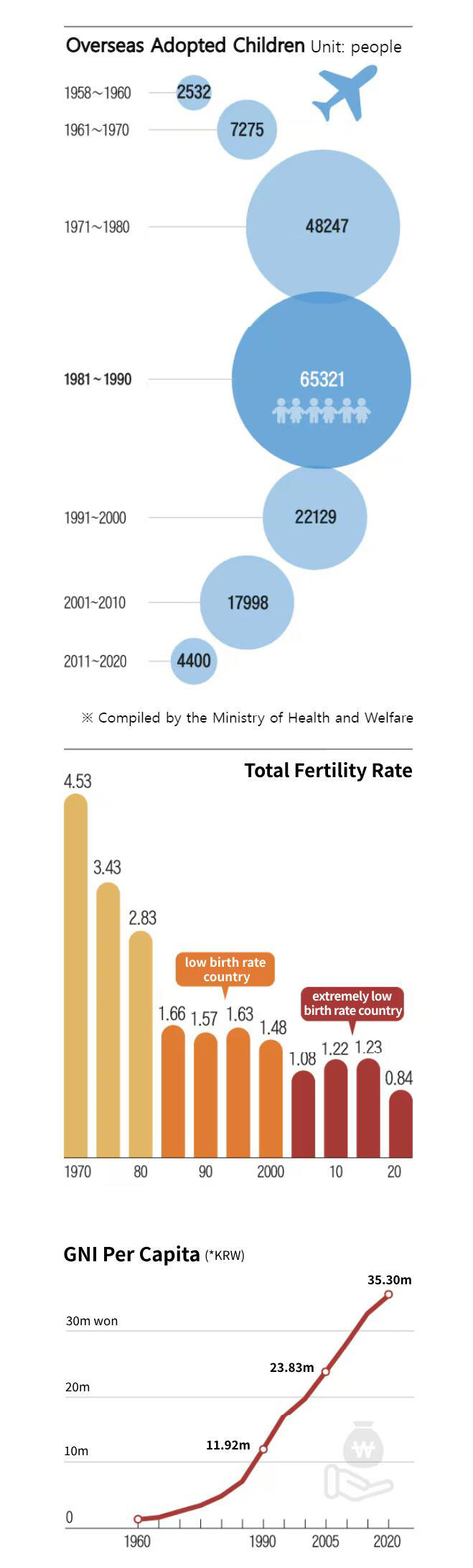
South Korea, which has been labeled a "child exporter" by sending 200,000 children abroad for adoption over the past 70 years. Finding roots is at stake as a comprehensive problem has been revealed in the management of adoption records for those who were recently adopted abroad. It has been revealed that not only adoption institutions but also public institutions that were willing to receive private records and manage them have concealed the problem. The 'PD Notebook' examines the true nature of the adoption record computerization project, which has been carried out for 10 years since 2013.

adoptees who believed in false records

The "PD Notebook" met adoptees who had difficulty finding their biological families due to their adoption records. Park Sang-jo, a Danish adoptee, visited Korea more than 10 times in 35 years to find her biological parents. He gave up looking for his family, believing that the record of adoption of "orphan" by Holt Children's Welfare Association was true. However, this year, I suddenly find out that I have information from my biological father and I am shocked. Although his biological father was already dead, it was impossible to meet him, Holt did not comply with Park's request to provide adoption records to meet many brothers. Park, who overcame various obstacles and met his siblings dramatically, learned that his family had asked the agency to get him back, but was already rejected for leaving far away and had been looking for his whole life.