Home  

(Dis) Appearing Women in Nationalist Narratives (Part 1): Interview with Respondent

 
(Dis) Appearing Women in Nationalist Narratives (Part 1): Interview with Respondent A 
Conducted by Bina D’Costa[1], the Australian National University
January, 2000
 I (Bina)  gratefully acknowledge Ms Shahin Akhter’s insights and comments during and after the interview.
 
Opening Note: The following interview was conducted in India.  The respondent was not keen to disclose her identity.  For the sake of ethical research practice, I kept the interview unedited.
RA: It was a big drama.  There were two hundred women waiting for us.  Mother Teresa went there at the beginning of January or December.  It was the new Bangladesh government who invited us there.  She didn’t find any girls there.  She had seen only their hair, petticoat and some other things.  Their hair was cut because they were afraid that they’d commit suicide.  They did brutal things and kept the girls naked.  Many were half naked.  We haven’t seen them in this state.  Therefore, we can’t make any comments.  When I went there on January 21, 1972, I started this temporary house.[1] 
BD: Why were you chosen? Did it have to do anything with your Bengali ethnicity?
RA: I mean, we were not chosen as such.  But we were sent because of our experience.  Hossain Ali, the Pakistani High Commissioner in Calcutta — when Bangladesh came to be on December 16, 1971, it was him who declared that he accepted Bangladesh.  After this, Hossain Ali came and visited Mother.  Then went to Shishu Bhaban.  And then I was in charge of Shishu Bhaban.  He asked Mother, “May I take this sister with me? … To tell you the truth I’ve not been to Bangladesh from 1950 till 1972.  That means for 22 years!  And I have not spoken any Bengali till then.  I did not complete my study in Bengali as well.  I lost complete contact with Bengali! 
BD: Was it difficult for you to communicate in Bengali?
BD: Only to collect the war babies? 
RA: Also to do the relief work.  And he is the one who introduced me to the ministers there.  My Bengali was so bad that I always used half Bengali and half English.  Mujib used to say, “Bangladesher meye, Bangla kotha bolo.” (Bengali girl, speak in Bengali)… But Mujib was a great friend.  I could go to any Ministry without pass and ask for help, whatever I needed.  Most of the things were sent from here.  Only thing was that I needed protection for the sisters.  We were foreigners but we did not look foreigners over there.[3] 
BD: Had it been unsafe for the sisters otherwise? 
RA: Yes.  And also when I went there, no other nuns were working outside, in slums and villages.  They were all working in schools and hospitals.  And they worked in their own convents.  When I went there, I started to work everywhere with the sisters.  We never went less than three to do relief work.  And Mizanur Rahman[4] used to say, “You young girls are going out in the world.  Who’d take care of you if anything happens to you?”  So, I told him, “That’s the only thing I ask you.  To give us protection.”  As a foreigner and a visitor we needed protection from any hooligans or people who wanted to cause problems.  It was our work and I had no fear.  I had very young sisters with me.  One was a Bengali and the others were from Kerala.  So they had to learn Bengali and do the work.  We had so much cooperation from the government!  So there was no objection.  So also, when we took the children in, the government didn’t give us any trouble.  When we started sending the children abroad, they gave us passports for the children.  But they did not know even how the adoption was supposed to be going.  I was doing adoption all the time in India.  So, I had a lot of idea how to do the adoption work.  When I went there in the offices to arrange for the children, I had to help them to prepare certificates so they could leave the country.  And based on that they got the passport to go, as not in adoptions.  For Muslims and Christians, they do not go for adoption, but for foster care.  In India, however, Hindus can adopt Hindu babies.  At that time, in Bangladesh, there were no laws for adoption for the Muslims.  At least I don’t thing so… we were the first one to do the adoption, and the children had no religion so to speak.  And in Bangladesh no one was going to adopt them.  Therefore, the government gave us the permission and they gave us the passports.  Even ten days old babies went to Canada.  The only thing is that I had to get a photo, a passport, and book their flight.  They needed to reach the country of destination and from there straight to the hospital.  Many were put in the incubators.  I was there in Bangladesh for two years and eight months and worked in the adoption project… 
BD: What happened to the women who gave away their babies? Do you remember them?
RA: Most of the babies came from the nursing homes.  Midwives, ayas (child-carers) brought the babies.   
BD: Do you remember any of the nursing homes? 
         I know one case, whose father was an engineer.  The whole family was killed.  They were half buried in the sand.  After the Pakistani army moved away, she gained consciousness.  Her story has been written in the Bangladeshi newspapers but of course under a different name.  She didn’t want to have an abortion.  But later on had to give away her baby.  But otherwise, I think everyone went for abortion.  Nobody wanted Pakistani babies.  Nobody!  Neither the parents, nor the government and nor the women…In the course of time, we were getting pregnant women, but we didn’t know who they were violated by: the Pakistani army or by local men.  We always had pregnant girls there. 
         Babies, who the Pakistani army fathered, were all aborted in different clinics.  Otherwise parents couldn’t take the women home.  And they wouldn’t tell anyone if their daughters were raped.  When they realized that their daughters were pregnant they quickly got the babies aborted.  It was all done in secrecy. 
BD: You mentioned that many of the children went to Canada…
RA: Most were sent to Canada.  Some of the babies were sent to France and Sweden as well. 
BD: Have you met any of the Canadian sisters who were working here? 
RA: No.  There were many others who started working in Bangladesh.  But actually we were the first ones to begin work over there. 
BD: During our conversation yesterday you vaguely mentioned a prison where women were kept. Can you tell me more about that? 
RA: No, no! 
BD: Was that in Dhaka? 
RA: Yes, in Dhaka Cantonment.  They were locked up in the Cantonment.  Mother went to see the place.  They took her to see the place.  But not even one girl was there to be seen at that time.  We went with lots of publicity that we were going to work with the girls who had been violated by the Pakistani army.  But when we arrived we found almost no one.  They were all gone.  But we did find lots of babies.  Many of the children were given up for adoption.  We also did a lot of relief work. 
BD: Those were related to women? 
RA: No, in general for everyone.  We also did some rehabilitation work for women on the other side of the Buriganga.[7]  All were Hindu women.  No men, no grown-up boys.  The army killed all the men.  They dug up a big hole where they buried all the men.  And also the grown-up boys.  Women were left alone.  We started a program for helping the women.  I gave each women 5 rupee[8]  to do some small business.  They made a little extra.  Afterwards they continued to work with that small saving.  Then we gave them goose, ducklings, chicks and goats.  For the next three years we helped them to stand on their own feet.  That is how Jagoroni[9] came into being.  It was the “Widows’ Program”.
         For Muslims it was difficult to understand us.  They asked, ‘How can you not get married?  You are violating God’s command.’  Slowly, they also started to understand us through our work.   People were a bit fearful at the beginning.  The Corr[10], Fr. Timm[11]  and Fr. Labe[12] had helped us.
BD: Have you ever worked in any other war-torn country? 
RA: I myself did not.  But others did. 
BD: Was the experience any different from Bangladesh? 
RA: No.  For us, it was nothing new. 
BD: How many of you were there in Bangladesh? 
RA: Six of us were working in Bangladesh.  Rob Chowdhury, the coordinator for rehabilitation work had assisted us.   
BD: Was the number of war babies more in Dhaka? And also the number of abortions? 
RA: Yes.  It still remains as a scar in my heart.  The government allowed abortion on a mass scale.  They didn’t want any Pak child.  Either they were to be aborted or to get out of the country as soon as possible.  We had incubators and we were prepared to take the premature babies. 
BD: Have you requested the women not to abort the children? 
RA: Yes.  We also asked the nursing homes, ‘When the babies are born, please do not throw them to the dustbin.  Bring them to us if they are alive.’  But they didn’t care.  They were interested in the mothers only.  Babies were thrown into the dustbins…you see for any war when they lose the land they want to leave the issue behind.  That is why the Bangladesh government wanted to get rid of the children fathered by the Pakistani army. 
BD: Did the women speak about the actual rape? 
RA: No.  And we also didn’t ask them.  There was a wound.  We tried to rehabilitate them, tried to accept the situation they were in.  And we never asked them to write their names, neither their addresses. Stigma would remain if people knew. 
         Ok.  I am tired.  God bless you. 
BD: Thank you very much for your time.

~
[1] The first orphanage for war babies.
[2] Sheikh Mujibur Rahman, the first Prime Minister of the Peoples’ Republic of Bangladesh, who also was called at the time, the father of the nation.
[3] Immediately after the war, there was total chaos in the country.  Law and Order situation was very bad. 
[4] The Relief and Rehabilitation Minister, 1972.
[5] It was clear to me that she didn’t want to reveal any names.
[6] Off the record information about rape by Bengalis.
[7] The major river next to Dhaka city.
[8] Indian currency.
[9] A local handicraft and community shop run by the Missionaries of Charity sisters.
[10] A relief and rehabilitation NGO of East Pakistan.  Now the name has changed to Caritas.
[11] Controversial Human Rights Activist/Priest in Bangladesh. 
[12] One Italian Priest.

Bling Bling Girls scoren voor Unicef

 Bling Bling Girls scoren voor Unicef
Laura, Anouk, Julia en Lisanne, leerlingen van basisschool de Ieme in Veghel hebben met hun actie voor Unicef maar liefst 3778,30 euro opgehaald.

Het viertal, dat zich de Bling Bling Girls noemt, hielden op 30 mei een speciale actiedag waarin workshops, een sponsorloop, een ballonnenwedstrijd en diverse spelletjes geld in het laatje moesten brengen. En dat is dus gebeurd.

Esther Ekkel-Vorstenbosch nam, namens Unicef, woensdag de cheque met het grote geldbedrag in ontvangst. Het geld gaat rechtstreeks naar Joaninha en haar zusje Chica, twee aidswezen uit Mozambique.

Babies for sale

Babies for sale

When Slumdog Millionaire star Rubina Ali was offered for sale with a £200,000 price tag there was worldwide outrage. But it wasn’t a one-off.

A woman offers her daughter for sale, along with a young orphaned boy (below)


This child is special, an Oscar child. So now we want £200k
Dad offers Oscar girl to our Fake Sheik for £200k.
Read
Rubina's dad is an evil liar. I'll do whatever it takes to get her back
By Mazher Mahmood, News of the World investigations editor & Claie Wilson, 23/05/2009
There's a shocking new trend emerging - baby trading. Desperate mothers are selling their kids to the highest bidder. While others get pregnant to order...
The little girl stands out from the other children who are scrabbling about. She's barely two years old, with wide chocolate-brown eyes and a shock of black curls. Her mother looks tired and her young face is prematurely wrinkled. She jiggles her daughter from hip to hip, and the toddler giggles in delight. She's too young to be bothered by the dirty blankets heaped on the ground around her or the tatty old mattress on the floor. And she's too young to understand the business transaction being discussed between her mother, grandmother and the two men who have just arrived. Which is just as well, as the two women want to sell her - for the grand price of £8,000.
This is the reality of the growing European baby trade, and when Fabulous decided to investigate, we were horrified at how easy it was to buy a child.
Within a couple of hours of making enquiries, our investigators had been taken to a tiny village in a remote area of Bulgaria. Here, working adults earn less than one euro a day (around 90p), so parents are trading the only thing they have of any value - their children.
Buyers range from childless couples desperate for a baby to love, to paedophile rings. Children can be sold from anything upwards of £1,200. For families too poor to feed or clothe themselves, finding a buyer willing to fork out thousands for a child that they can't afford to raise, is like winning the lottery. Sadly, this often means they don't question their child's prospective new 'family' too closely.

Recently, baby trading hit the headlines when the News of the World revealed the father and uncle of Slumdog Millionaire star Rubina Ali tried to sell her to reporters. Her family valued her at £200,000 - because she wasn't just a child - but an 'Oscar child'. The sale was stopped and her father was arrested and questioned by police in Mumbai. He has since been released, but the investigation is ongoing and Rubina's fate remains undecided.
In countries such as Bulgaria, China and India, poverty is rife. Increasingly, children are being seen as a commodity to be sold to the highest bidder. As demand now outstrips supply, in some countries women are getting pregnant to order and selling their unborn babies to any willing purchaser.
Kate Allen, director of Amnesty International UK says: "Poverty is the main cause. We need to restore people's basic human dignity to have any chance of preventing this practice."
Back in the remote Bulgarian village, the mother is agitated and keen for our investigators to agree the price for her daughter, who we have been told is called Desislava.
"I want to give you this child," the girl's young mother says. "It's hungry all day, it's miserable. What can I do?"
There are a handful of other children - many of them partially clothed, all of them filthy - wandering around outside the ramshackle house that is home to an entire family and their livestock. It's not clear if the children are brothers and sisters or unfortunates with nowhere else to go.
"We are so poor," adds the baby's grandmother, a 70-year-old woman who is standing barefoot next to us. "The children are hungry. We have no bread, we have nothing."
It's a shocking scene - and almost unbelievable to think that in 2009, families are so destitute they would sell their own flesh and blood.

As our investigator talks to his interpreter, the desperate grandmother offers a 'cut-price deal' for another child.
"This is Dimitar," she says, pointing to a scruffy barefoot toddler. "He's an orphan and we can't afford to raise him." Then she demands 10,000 lev (£4,000).
Not once do either women ask - or seem to care - what would happen to the children if these men bought them. As our investigators make their excuses and leave, the grandmother, sensing the deal is off, offers them a bargain.
"You can have the boy for just 6,000 lev [£2,400]. You can take him with you now." It seems no price is too low.
Baby trafficking was only made a crime in Bulgaria in 2004 and the maximum punishment is just two years in prison. No surprise then, that when a child can be sold for thousands of pounds, the country has become infamous as a human supermarket.
Some poverty-stricken families hand over babies to local loan sharks to pay off their debts, who in turn sell them to the highest bidder. Other women get pregnant deliberately to sell to childless couples around the world. Like the woman our investigators found in a town two hours from Bulgaria's capital, Sofia. She claims to have sold one child, and now six months pregnant, she wants to sell her unborn baby too.

This pregnant mother of five wants to sell her baby as soon as it's born
"I have five kids," she told our reporters. "But they have no shoes, no clothes and no beds. I'm sick and my husband has asthma. Our money goes to pay debts at shops as we buy food on credit and we're left with nothing. In winter there isn't even wood to burn. We live in poverty, like dogs."
For this mother, it seems getting pregnant and selling her babies is the only way she can survive. Our reporter informed local authorities of both the cases we discovered in Bulgaria and they assured us they would investigate further.
Children's charity UNICEF says Eastern Europe has one of the biggest markets for child sex and domestic slaves. In 2006, 10 Bulgarians were sentenced to up to six years imprisonment for selling 23 babies to French families for around £4,500 each. One 16-year-old Romanian girl was arrested after she complained a British woman who offered to pay her £9,000 for her baby, only paid £7,000.
Police have also investigated hundreds of similar cases involving Bulgarian and Romanian babies being sold in neighbouring Greece and Italy.
Tragically, most cases go unreported. No one knows exactly how many children are bought and sold every year. Save The Children estimates it's close to 1.2 million - with the gangs involved making up to £16billion profit a year.
"There are still millions of children in both rich and poor countries who are living in horrific conditions of humiliation and abuse," says Bill Bell, Save The Children's head of protection. "Across the world there are currently 1.8 million children trapped in the sex trade, over a million children risking their lives working in mines, and millions more, some as young as six, forced to work up to 15-hour days as domestic workers. These children are treated as commodities, and can be lent or sold to other owners without warning."
For the criminal gangs it's easy money and, as our investigation shows, it can take as little as two hours to find a baby for sale.
"Despite police activity, as long as you have the money, you can buy a baby or young child in Bulgaria," says one Bulgarian informant. "No one asks whether you're a child abuser. It's like buying something from a market stall."
Bulgaria is not the only country where child trafficking is rife. Romania, Guatemala and India also have a thriving trade. Some of these children may end up as part of a loving family - so desperate for a baby, that they resorted to this horrific underworld - but most will be used and abused, bought and sold time and time again until ill-health or death gets to them.
And it seems although the authorities know this is a growing problem, there is very little they can do to stop it.
Adrian Lovett, director of campaigns at Save The Children says: "Children in Eastern Europe and across the world are bought and sold as if they are commodities to be used as slave labour or for sexual gratification. Fabulous' investigation shows how easy it is to traffic children - and that it can be cheaper to buy a child than a second-hand car. How can that be right? Those who trade in children must be made accountable."
Save the Children can be contacted at Savethechildren.org.uk or on 020 7012 6400 (or 00 44 20 7012 6400 outside the UK). UNICEF can be contacted at Unicef.org.uk. For Amnesty International, visit Amnesty.org.uk.
'I want to give my baby away'

Across the border in Romania, another mother has advertised her unborn baby in the small ads of a local newspaper.
Marusia Moraru, 39, placed an ad which read: "Family with three beautiful and smart children, wife five months pregnant. We are looking for a Christian family with no children to take the baby for adoption. We want a serious and responsible family."
Marusia claims she doesn't want money for the unborn baby, believed to be a boy, but her advertisement has caused an international outcry. In an exclusive interview with Fabulous, she insists: "I don't want him. I don't feel anything for him. I want whoever we choose to be at the birth and to take the baby straight from the hospital bed. This baby inside me is not a person yet, so I don't have any responsibility other than to find it a good home."
Even more bizarre is the reason behind Marusia's baby giveaway - her husband, Marian, 40, has decided to become a monk."It wasn't until I was five months pregnant that Marian made his decision. I support him in it, but I can't take care of another baby alone.
"There has been a strong reaction to our advertisement, but we only want what is best for our child."
Marusia has three other children: daughters, Regina, 15, and Malika, 17, and a son Kelemen, 10. She claims that her fourth pregnancy was unplanned and unwanted. "I discovered the pregnancy at eight weeks, but I'm Catholic and my religion views abortion as a crime."
It is also a crime to try to arrange a private adoption in Romania, and the couple are soon to be interviewed by social service inspectors. Child protection agency manager Florin Ion says: "It's illegal and practically impossible for a family to propose to whom their child should be given for adoption."
But Marusia insists that she is doing nothing wrong. "I know that a lot of mothers will find it hard to understand," she says. "But the baby will have a better life. There are so many kind, loving families out there." There's been huge interest in Marusia's unborn child, and she admits that she and her husband has been secretly conducting interviews for prospective 'parents.'
"We've been speaking to different couples," she says. "We'll have to meet the parents of the couple that take our baby because it's important it is loved by a whole family," she pauses, then adds defiantly: "We won't be rushing into any decision. It is our baby's future, after all."
Additional reporting: Amanda Cable Photography: Getty Images, Europics at [cen]


Your comments
This article has 12 comments
These so called baby traders, are nothing more than than the slave traders of old. A child is not a commodity to be brought and sold to the highest bidder, it's a wonderful and unique gift to be loved and cherished. There are many people in this world who are unable to have children, who would give an unloved and unwanted child a home without having to pay for it. I agree with Elaine on this one.
These so called celebritities who adopt these children are not really intrerested in the child they've adopted, to them it's like shopping for things that they will never really use, but must have them anyway. They have a nanny to look after them. These adopted children are really just status symbols.
Lucy may your dream come true.
By Lorna Wanstall. Posted May 29 2009 at 6:51 AM.
Brenda is right. This ethnic group, familiar all over East Europe, has long standing traditions in selling people for money. This is for them the ‘normal’ way for obtaining a bride or (as mentioned above) adopts a baby. There is no law which can eradicate this tradition, no matter how inhumane it may seem. Roma are outside the law anyway, having a semi nomadic existence with main profits in burglary and prostitution.
By whasaap. Posted May 27 2009 at 8:14 AM.
its a great pity adoption is not ratified in these countrys - as mum to a adopted daughter i can put hand on heart and say our adoption is 100% legal and my dd is very loved by both her birth mum and I

this is such a scary article to see and i hope that the future will bring an end to child trafficing
By CAROL. Posted May 26 2009 at 11:36 AM.
This is one of the saddest things I think I have ever read. I can't help but feel sorry for both parties involved – the women so destitute that they consider selling their own flesh and blood and the childless couples so desperate for a baby that they'll resort to the dark world of child trafficking. But most tragic of all is that, more often than not, these poor babies will be sold into a world of abuse or slavery. Thank goodness for reports like this, which highlight such horrors and hopefully help bring them to an end.
By Katherine. Posted May 26 2009 at 11:24 AM.
well, brenda, that is precisely why babies are being sold, because some people cant have any of their own.
By nevermind. Posted May 25 2009 at 2:02 PM.
What has happened to our world these days? Buying and selling babies... this makes me sick!!! We are human being for God sake!!
By Allen. Posted May 25 2009 at 8:04 AM.
To Mr.Georgiev,please,don't be Bulgarian,dear!Bulgaria doesn't need people like you!
By Bulgarian1. Posted May 24 2009 at 10:02 PM.
I am so ashamed to be called contemporary Bulgarian :(
By Georgiev. Posted May 24 2009 at 5:04 PM.
Well can i say

I think this is evil, no child should be sold at all
their are couples who want children and can't

they are the most evil the will pay when the lord ask them why
By brenda. Posted May 24 2009 at 4:35 PM.
I am not familiar with the situation in Romania or India, but don't you think that in Bulgaria at every corner you can buy a baby! The pictured people are not even Bulgarian ethnicity. They are known in the country as a winner of the problems. All efforts of the state to educate and integrate failed, due to simple reason that they are undemanding to stay in school, they do not want to work ... The state organized many sex education programs for the use of contraceptives and the like, in order to reach the many families who can not feed their children. I remember state projects, which literally gave state houses of representatives of this minority, but a year later these houses were like sheds!
One should not think, the money from the report will feed the other children! No! Most likely it will be spend for buying alcohol, gold jewelry or a car! In their ethnicity it is normal to buy brides, and their weddings continue few days with around 200 - 300 guests! They give 10 000 - 20 000 euros for a beautiful bride (of course uneducated - it is important to be able to steal, for example) and another 5 000 - 10 000 euros for a wedding, and then complain that they can not feed children who continually born!
I just want to say - do not evaluate their ways, breaking them trough the prism of your values! These people are not like you and us and never wanted to be!
By a Bulgarian. Posted May 24 2009 at 3:26 PM.
What about all the poor kids who live in the UK who lived in poverty and have ended up in care? Yes, the mothers who sell their babies are sick, but the mothers who buy these babies instead of fostering or adopting one/some of the thousands of kids in care in the UK are just as bad. Angelina and Madonna are making it too stylish to have a handbag baby from overseas.
By Elaine. Posted May 24 2009 at 12:57 PM.
for 17 years now my husband and i have tried for a child,reading this makes me feel sooo frustrated :o(
By lucy. Posted May 24 2009 at 7:20 AM.

Ga. set to become 1st state with embryo adoption law

Ga. set to become 1st state with embryo adoption law-->-->
Posted on May 28, 2009 | by Michael Foust

ATLANTA (BP)--The nation's first law governing the adoption of embryos is set to take effect in Georgia after being passed by the legislature and signed by the governor.

The "Option of Adoption Act," which will go into effect July 1, will provide safeguards for both parties involved in an embryo adoption, which is a unique form of adoption in which a couple -- often an infertile one -- adopts one or more surplus embryos from a couple who has undergone in-vitro fertilization (IVF).

Embryo adoption allows the adopting mother to experience pregnancy and has been promoted by pro-lifers for years but, until now, has not been governed by the laws of any state. Significantly, the Georgia bill amends Georgia's adoption laws to make clear that embryo adoption in fact is a form of adoption. The law also allows adoptive parents to file in court for a final order of adoption (for the child who is born as the result of the embryo adoption), which supporters of the new law say clarifies that the adopting parents are eligible for claiming some but not all of their expenses for the federal adoption tax credit, which this year is more than $11,000.

Although embryo adoption tends to be cheaper than traditional adoption it nevertheless can still cost several thousands of dollars.

Couples who undergo an embryo adoption in a state without such a law as Georgia's must sign private legal contracts that treat the embryo as property. The new Georgia law defines an embryo as "an individualized fertilized ovum of the human species from the single-cell stage to eight-week development."

The law has the support of the nation's embryo adoption programs, including Nightlight Christian Adoptions, which runs the nation's oldest embryo adoption program -- the Snowflakes program.

"Science has outpaced our legislation in clarifying the rights of the parties in potential disputes involving embryo transfer between families," Ron Stoddart, executive director of Nightlight Christian Adoptions, previously told Baptist Press. "There needs to be certainty, particularly before an embryo is thawed and implanted in the womb of an adopting mother."

The law makes clear that once the biological parents of the embryos and the adoptive parents have entered into a written contract, "the legal transfer of rights to an embryo shall be considered complete."

"A child born to a recipient intended parent as the result of embryo relinquishment ... shall be presumed to be the legal child of the recipient intended parent," the new law states.

Dan Becker, the president of Georgia Right to Life, said the law is noteworthy not only because of its first-in-the-nation status but also because of the way it defines an embryo.

"We became the first state in the nation to, in our code, define an embryo as beginning at the single stage," he said. "... That's a huge move forward and one that was fought quite aggressively by the pro-abortion side of the equation."

Republican Gov. Sonny Perdue signed the bill into law May 5. It passed the House 108-61 and the Senate 45-9. Both chambers are controlled by Republicans.
--30--
Michael Foust is an assistant editor of Baptist Press.

Bulgaria sees alarming rise in child-abandonment cases by young mothers

Bulgaria sees alarming rise in child-abandonment cases by young mothers

16 May, 2009, 08:15

With teenage pregnancy on the rise in the Eastern European state of Bulgaria, orphanages say more children are being abandoned by young parents.

Thousands of children in Bulgaria are living either in state-run homes, or in facilities operated by private charities. And the country's strict adoption laws means the children may remain in the institutions for many years before they find new families. To add to their unfortunate experiences, the conditions they are forced to live in are often far from ideal.


Read more

The vast majority have at least one living parent. But the children end up in the care of orphanages after being abandoned by parents who can't cope with looking after a child. Many of the mothers are still children themselves.

”For 2006, ten thousand children were born to girls under the age of sixteen. And they were born in ghettos, born in very poor families,” said Slavka Kukova, a human rights activist. “Most of these children are sent to institutions because the people around would advise their mothers to do that in order for the children to survive.”

Because of Bulgaria's laborious adoption process, it can take a prospective parent up to 4 years to complete all the necessary paperwork.

Luckier children waiting to find a new family may end up at a privately-funded center like a children's village in the town of Dren, which is run by the charity 'SOS.'

Here the youngsters live in small family groups each with a house mother who takes on the role of foster mom. The charity is based in Austria, but draws donations from around the world. Andrea Kruse is a United States Peace Corps volunteer who works in Dren.

“They enjoy various activities, playing on the skateboard, bikes, computers,” she said. “They love discos, so we have disco nights once in a while.”

Less than a 30-minute walk away is a state-run orphanage. Locals said that the children there don't get anywhere near the levels of care, facilities, and interaction as the orphans at the SOS village.

But they do attend the same school – creating an uneasy atmosphere of the 'haves' and the 'have nots.'

For Bulgarian authorities, the illegal trade in babies, which mostly occurs in poor villages populated by Roman Gypsies, is another big problem.

Local journalist and documentary-maker Martin Karbovski explains how easy it is to exchange kids for cash.

”I was pretending to be a Greek lawyer and there was one Greek-speaking woman in my team. We wanted to buy a child from a pregnant woman in the village,” he said. “We knew, I might say, I was his father. We didn’t quite yet understand the procedure, but we knew how much it would cost. We knew she wanted to sell her child for 1000 euros.”

The United Nations says 4.1 percent of babies born in Bulgaria are to teenagers. But other groups put that figure at almost 10 percent. It's clear that when it comes to standards expected of a European Union country, this fledgling member has a long way to go in achieving social care for the poor and the young.


http://www.russiatoday.com/Top_News/2009-05-16/Bulgaria_sees_alarming_rise_in_child-abandonment_cases_by_young_mothers.html

When Clients Attack - Part I

 
“No one taught them etiquette
It will wash all over me
Today I don’t need a replacement

The Blevinses Go to Bulgaria

The Blevinses Go to Bulgaria
 
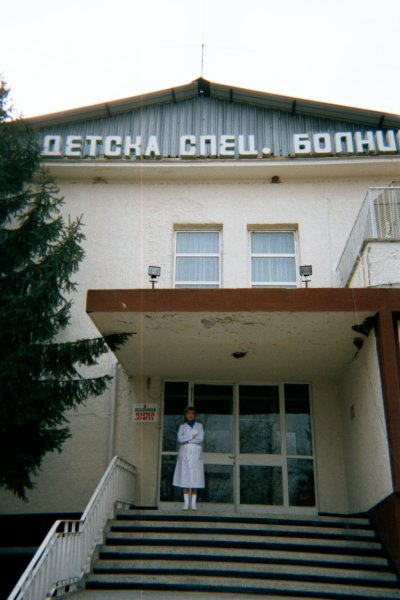
“Specialized Children’s Hospital” in Buzovgrad
Photo by Teri and Mark Atkinson

Trud story

Trud story


    This article was sent to us as a scanned PDF file, making it impossible to print out and translate for some time due to the limited memory capacity of a decade-old printer. If you want the originals, email us until we get some sort of document archive up and running.

    However, it is about the most comprehensive accounting of the scandal we could find in any Bulgarian online media outlet. It contains some interesting information not repeated anywhere else — perhaps the reason it has never appeared in English until now. Also, by translating it ourselves, as native English speakers we were able to render it into smoother, more natural prose, as opposed to the often-fractured parsings found on web sites like Bulgaria Online.

    A little necessary background information is in order: Trud, like many European newspapers, doesn’t really pretend towards impartial news coverage. In other words, it has an agenda.

Busted in Bulgaria

 
Chapter Fifty-Eight
 
Busted in Bulgaria
(With a little help from the Cases)
“Come on down, the devil’s in town
He’s brought you sticks and stones to bust your neighbor’s bones
He’s stuck his missiles in your gardens
And his theories down your throat
And God knows what you’re going to do with it
‘Cause I certainly don’t”
-Matt Johnson
       On April 12, 2001, we received  this email from the director of the “Alaska agency,” Adopt An Angel:
Hi, how are you?  I am sorry for what happened in Russia to you.  That is so sad. 
The reason that I am curious about BB is because they kept saying that my agency was the reason why their clients couldn’t go pick up their children.  It’s kind of funny since my clients were picking up their children.  It was a complete lie.  Thanks for listening.
    Denise’s reputation and words were coming back to haunt her.
    This is not, as the alert reader will realize, the first time she’s trashed another agency to distract attention from the failures and misconduct of her own. EAC, of course, was subject to the same treatment in the form of a nonexistent lawsuit supposedly brought by Denise.
    But it also reminded of us of an email exchange we had back in early 2000, with Dellory Matthews, then public relations director for Focus on Children (a Wyoming-based agency forced by its own incompetence and  lack of preparation for the March 2000 rule changes to start working with Amrex after clients had been waiting well over a year to bring children home) told Daniel in another now-lost email that BBAS had been spreading innuendo about her agency’s Vladivostok program.
    Denise was reportedly telling prospective clients that FOC could charge less for an adoption from the same orphanage because they paid their facilitators so poorly. “In reality,” Matthews claimed, “their facilitator is just jealous of our facilitator’s connections.”
    Since BBAS’s Vladivostok program was subsumed into Amrex’s operations when Russia changed its ways, we never heard more about this and presumably the dispute is moot.
    Back to the present. By the middle of April 2001, continuing reports about Burgas and illegal dealings were beginning to filter out of Bulgaria. 
    A client of Adopt An Angel sent us a link to a story in the Bulgarian newspaper Standart, which was then picked up and translated on Bulgaria Online.
    Much, much more was to follow regarding Burgas, Kurjali and Buzovgrad and most tellingly, Valeri Kamenov and how all of these entities are interrelated (not that we have ever found any hard, evidential facts to link them together yet …but …):
    This was sent to us on April 19, 2001. We can’t vouch for the accuracy of this, and the translation could be better, but it was troublesome nonetheless. 
    The Director of Mother and Child Home in Bourgas, Dr. Zhivka Sabrutova has sold 20 kids to aliens last year.  The tariff was US $40,000 per child.  This is what a source from the regional division of the Security National Service communicated.  The Doctor was acting through a private, unlicensed company.  The investigator Ivo Dobrev [we don’t think this is any relation to Dobrev, BBAS’s Bulgarian attorney in Sofia] has already completed his inspection.  Dr. Sabroutova was charged for a crime on working place. The sentence would be up to 8 years of prison and taking off physician’s rights.
    The adoptive parents to be paid the huge amounts and signed the papers in the Bulgarian language.  They never suspected they were defrauded. The aliens were convinced that these were the relevant costs for an adoptive child under our laws.  The whole procedure in our country costs a total of 1,000 Leva.  The last who signs the decree for releasing from citizenship is the President.  The tariff for Denmark, Italy and USA is higher.  “We gave 60 children to aliens last year. I don’t have any violations.  Whoever thinks I do is supposed to prove this!” Dr. Sabroutova stated. 
    The scandal with the trafficking of children from the orphanages burst out in February, after an attempt to export 3 minor children out of Montana [an orphanage and city in Bulgaria – not the US state of the same name].
    The materials from the inspection in Burgas have already been sent to Sofia.  Other orphanages in the country are being investigated as well.
    Our goodly Dr. Sabrutova was being hung out to dry. But were these allegations true? Was she pocketing money? We seriously believed it, but not in the amounts being reported in the Bulgarian media.
   It appears that the reporter had no understanding of the American adoption process, or of the real expenses involved for us to adopt Bulgarian children. Was this what Denise Hubbard had meant when she said that the Bulgarian process would be just like the Russian process in a few years?
    Suddenly, on May 30, 2001, we were sent a startling bit of evidence that the bomb we had dropped on the Minister of Justice regarding our dealings with BBAS had hit its mark. 
   A friendly translator in Bulgaria emailed us a translation of a story from the Bulgarian newspaper Novinar (“News”) that had appeared in the original the previous day.
    BBAS, Valeri Kamenov and Daniel and Elizabeth Case were mentioned by name. (The language is as translated, so that’s why it may read a little oddly to native English speakers).
The National Investigation Service Intersected A Child Traffic Channel

    An officer from the military counter-intelligence has sold out abroad dozens of
children from the orphanages in Burgas, Karjali and Kazanlak [Buzovgrad], an investigation of Novinar has found out.
    The Capital Investigation Service has filed a lawsuit # 98/2001 against the
directors of the social establishments. Yesterday Sofia District Court removed
them from office, with view to not prevent the investigation. The organizer of
the network is the former Lt. Colonel from the military counter-intelligence,
Valeri Kamenov, who was the representative of the US agency BBAS. Upon the
search in his home, currency for 800,000 Bulgarian leva (about $ 400,000),
furniture for 650 thousand leva and 5 automobiles were found out. Kamenov
refused to provide explanation about the origin of the money.
    For each child adopted, a commission of $15-20 k has been taken, the
investigation of the National Investigation Service found out. Almost all of the
children had been sent to the USA.  Each child must receive 3 written 'decline-to-adopt' declarations saying that Bulgarian families do not want him, to be made available for international adoption. The directors collected the declarations without showing the orphans, saying that only sick and injured children have remained at the orphanage.
 
The Mediators Were Getting $15-20K Out of Each Adoption
 
    The prosecutor's ruling was based on an elaboration completed by the National
Investigation Service (NIS). It was assigned by the Supreme Cassation
Prosecutor's Service (SCPS) and it was under the personal observation of the
Chief Prosecutor Nikola Filchev.
    The reason for this elaboration has nothing to do with publications in the
press, the officer from the security services was categorical before Novinar.
The network disentangling started on April 7 1999 with a fax received at SCPS
from a German journalist. He [was] alarmed about an investigation completed by the
City Prosecutor's Office concerning trading of minor children.
    The German journalist Edmond Koch located an Internet address of a mediating
company and stated his will to adopt a Bulgarian child. He even came to
Bulgaria. The lawyer O’Brian, who is a representative of the mediating company
BBAS in USA, fell into the trap. Along with her, the police arrested the American resident alien of Bulgarian origin Anna-Maria Velcheva Gromann, and her
husband Dr. Oliver Gromann. The report made with a hidden camera was aired by the Munich TV channel PRO 7.   The case was widely published by the local mass media.
    Upon the search in O’Brian’s computer, information about bargains with children was discovered. She admitted to the police, that 15-20 thousands of dollars from each adoption were going to the accessories in Bulgaria. The leading figure there was someone with General's rank.
    As a result of the operative elaboration of NIS it was found out, that the word
is about Valeri Kamenov, 47 years old, born in Vidin, a former officer from the
military counter-intelligence. Upon Kamenov's arrest, currency in cash, furniture and five automobiles were found in his home, at the total value of over 1 million German marks. Kamenov was released against a bail of 20,000 leva, which he paid right away.
    NIS has found out, that Kamenov has been associated with Zhivka Sabrutova,
Yordanka Gospodinova and Ivelina Panova. After they appealed before the court,  they paid bails only of 3,000 leva for each, instead of the originally required 5,000.
    The paperwork kept in the orphanages was formally perfect, the cops found out. According to the Family Code, and Regulation # 17, of the Minister of Justice, a Bulgarian child may be adopted by aliens only if he has turned 1 year of age and there are at least three 'decline-to-adopt' declarations from Bulgarian families, after he has been seen by them. Then, the Minister of Health offers to his colleague at the Justice to grant consent for the adoption. The last word belongs mandatorily and solely to Sofia District Court.

    According to the statistics, 4,000 Bulgarian families are waiting to adopt a
child. But when some of them were visiting the mentioned orphanages, they have been told that only sick, injured, or minority children have remained there.
Without to be granted with the opportunity to see them, they were asked in a
persistent manner to sign the 'decline-to-adopt' declaration to take some of
these children.

    It has been found out, that the healthy children have been raised under special
conditions and separated from the others. The second law infringement on the part of the directors, that they have provided information to the mediators who prepared catalogues with pictures and data. The aliens have been told, that huge State fees have to be paid in Bulgaria.

    The arrested in Munich, O’Brian, has quoted on the behalf of BBAS (Building
Block Adoption Service) a price list with the following fees:
- Filing an application - 275 $
      - Program fee 3,000 $
      - Identification fee - 1,500 $
      - Bulgarian program fee (?!) - 12,000 $
      - Escort - the real costs incurred
      - Document fees - 680 $

    There were additional fees, too: Orphanage attendance, postal fees, fees for
re-adoption and finalization, fees for American lawyers, immigration fees,
translation of child's documents, travel costs of parents and children,
confirming the authenticity of the documents, standard medical tests upon
arrival in USA.

    There was one more complaint against the mentioned company BBAS. In a letter to the Minster of Justice, Teodosiy Simeonov, the American family Daniel and
Elizabeth Case have filed a complaint with regard to the procedure, according to
which they adopted a Bulgarian child.

    The media have been ma[king] noise about the necessity of a transparent  mechanism,  the need of Adoption Agenc[ies] and creating new texts in the Criminal Code concerning child trafficking. The latter needs only a suggestion from the Ministers of Health and Justice. No matter what the composition of the next Parliament is going to be, it is supposed that a consensus can be achieved quickly and easily. The lack of legislative initiative for normative solution of the problem logically raises suspicions, to which nobody should feel offended.
   WHOA! I got up that morning and read this with my mouth hanging open. What the…? 
   I had heard allegations that Dr. Sabrutova separated out the “healthy adoptable” children (read Anguel, N, and several other families in the U.S. and elsewhere) from the rest of the orphans in Burgas, but had no proof.  
    We have also been informed that of the “three families” that signed off on these children, many of them were the same three families who may have been friends of Dr. Sabrutova. 
   Also, rumor in Bulgaria had it that back in the late 1990s, Dr. Sabrutova would lie to birthmothers who brought their babies into the orphanage. She would tell them that they could come back in six months to reclaim their babies; but in reality, by that time, they had inadvertently relinquished their rights to them and were too ignorant to fight it. 
   These are strong, sickening allegations, and we really hope they aren’t true. The jury is out.
    We have, however, provided our own translation of the most comprehensive article about the affair that we received from Bulgaria, one that appeared in the newspaper Trud. It has some other interesting, and disturbing, details.
    But what was really interesting about this article was the mention of this “Candace O’Brien” attorney being arrested in Germany in April 1999. For some time, we had been trying to figure out how Denise had originally hooked up with Valeri in Bulgaria.
    She had made mention of “saving” the adoption of the very first Bulgarian child BBAS had placed from Buzovgrad with a family in Louisiana, who still post infrequently to the EEAC list. 
    Both the family in Louisiana and Denise had always been pretty mum on the circumstances, but once Denise let slip to Sue Corrigan that she had gotten a few Bulgarian clients from an attorney who had decided to stop the business. She had told another client something similar.
    Was there a connection here? Was this attorney’s arrest in Bulgaria what got Denise in the door and connected with Valeri in the first place? 
    The article mentioned that Candace O’Brien was arrested in April 1999 — the same month that Denise had begun “exploring” expanding her adoption work into other countries, according to the minutes of BBAS’s board meetings filed with the state of Ohio when her license came up for renewal
    The Bulgarian program was first mentioned in June 1999 and the first children began appearing in late June and early July on their website (Anguel and a few other Burgas and Kurjali inmates were featured).
   The first clients may have been Russian switchovers from Volgograd who were promised the impossible timeline of four to six months. The first family to travel went to Kurjali to visit their children in July 1999 with Richard J. Marco.
   This account was written up in the BBAS August 1999 newsletter, back when Denise was corralling us all in by touting the health of the Bulgarian children and the speediness of the Bulgarian process.

Minister Frattini meets with foreign minister of Belarus Sergei Martynov

Minister Frattini meets with foreign minister of Belarus Sergei Martynov
Rome 24 February 2009

Minister for Foreign Affairs Franco Frattini met today with Belarus foreign minister Sergei Martynov.

 Their conversation focused on bilateral topics concerning both the economy and culture, and also touched on visas for medical treatment and adoptions.

With regard to relations between the European Union and Belarus, the meeting offered an opportunity for Minister Frattini to encourage Minsk in its open attitude toward Europe and to confirm Italy’s consensus with Brussels’ approach to the Belarus government. Minister Martynov expressed his appreciation for the active and positive role that Italy has played thus far in fostering his country’s integration into the European Union.

At the end of the meeting the two ministers signed a Memorandum of Understanding on continuing consultation between foreign ministers on matters of common interest.