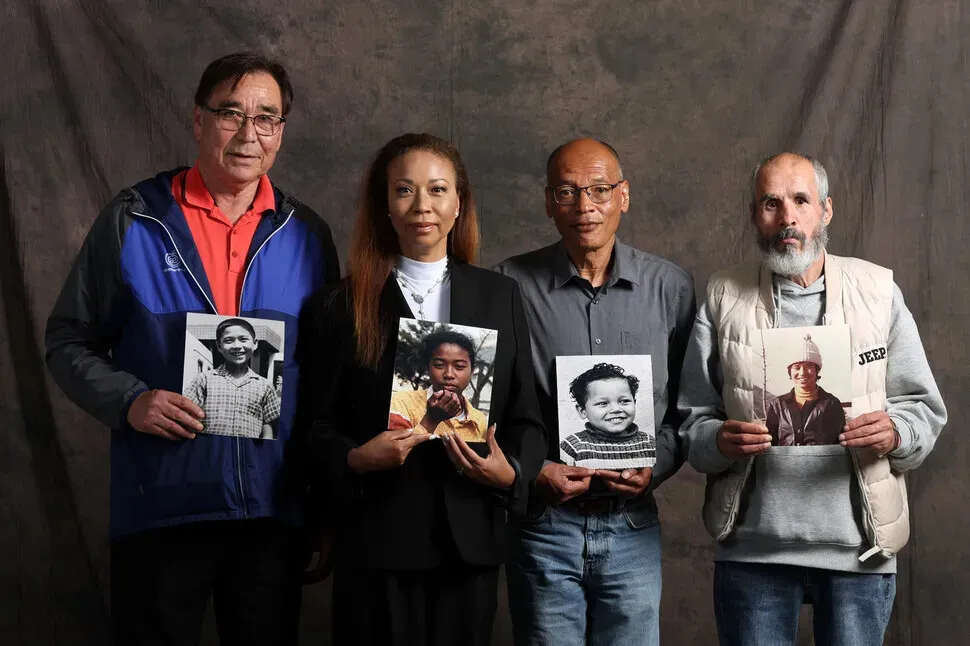
Intercountry adoption has not only caused suffering, these adoptive parents believe.
The cabinet wants to stop intercountry adoption due to abuses. Martin and Rosanne van Dam, awaiting their fourth adopted child from South Africa, hope it does not come to that. 'Most adoptees look back on their childhood with fondness.'
Jeroen den Blijker
Healthcare editor
Published on June 3, 2026, 11:45
Martin and Rosanne van Dam have followed it all closely. How the political establishment, after much commotion, decided to phase out intercountry adoption, and even wants to stop this adoption permanently on January 1, 2030.
To some extent, they also understand that reaction, following the scathing conclusions of the Joustra Commission. In 2021, the commission established structural abuses in international adoption practices. Child trafficking, fraud, and deception were the rule rather than the exception during the period 1967–1998, according to the commission.
But do they agree with that adoption freeze? No. “This policy is far too black and white,” says Martin van Dam, sitting at the dining table in their home in Veenendaal. “As if intercountry adoption has only caused suffering.”
The door is open for another child.
Martin (43), black curly hair, yellow shirt, is the owner of a communications consultancy. Next to him sits his wife Rosanne (45), dark blonde, serious expression. She is still busy with her lunch ('Sorry, I didn't have time earlier'), is trained as a doctor and owner of a midwifery practice. Together they previously adopted three children from South Africa: Shawn (16), Josiah (13) and Hannah (7).
And they have decided to adopt another child. Or, as Rosanne puts it: “The door is open for another child who might need us.” She phrases it this way for a reason, she explains. “For us, adoption is not about us or about expanding our family, but about what is best for the child in question.” In total, there are currently about four hundred adoption procedures still ongoing, the cabinet recently reported. These must be completed before 2030.
Martin: “Actually, that is how we arrived at adoption back then as well. From the thought that there is a child in our hearts and in our home who needs a family to grow up in. Of course, it all started with an unfulfilled desire to have children, which is legitimate, I think. But then we started exploring all possibilities, including foster care. Ultimately, we ended up with adoption.”
Rosanne: “Fundamentally, adoption is of course not a good option for a child, we also add. Because in an ideal world, children would simply grow up with their biological parents. But unfortunately, the world is not ideal.”
Is adoption still a good idea?
Their file for the fourth child is now in South Africa. Rosanne: “We already have approval in principle for adoption. No, we haven't received a phone call yet: so there is no match yet. Of course, it is entirely up to South Africa to take further steps in that regard. Our primary duty is to be as transparent as possible regarding investigations by Child Protective Services and the Central Authority, all in order to achieve the best possible match.” The Central Authority for International Child Affairs monitors compliance with the adoption law.
But is international adoption actually a good idea, after all the suffering unearthed by the Joustra report? After all those stories of recent years about adoptees who are victims of adoption abuses, who struggle with questions about their identity, partly because their biological family can often no longer be traced?
Martin and Rosanne van Dam have naturally thought and discussed this a great deal. And, says Martin: “Then I find it regrettable how much, after 'Joustra', the spotlight has fallen on people who have primarily had bad experiences due to their adoption. I mean: that mistakes were made is evident. That suffering deserves recognition, and we also say: help these people. And do it better than the government is doing now. Help them with the restoration of their identity, with roots trips or DNA testing – which, unfortunately, is not happening now.”
“On the other hand: research by Statistics Netherlands also shows that 70 percent of adopted people actually look back on their childhood with pleasure. You just rarely hear those voices in the media.” Rosanne adds: “Because good news is simply no news.”
Positive stories
They are well acquainted with those positive adoption stories themselves. After all, until a year ago, Martin was chairman of the Adoption Association of the Reformed Denomination, an association for adoptive parents that also has a section for adopted children and young adults. He also served on the advisory board of Inea, the expertise center that supports internationally adopted individuals. Inea was founded in response to the Joustra report.
Martin: “I have also had tough conversations with opponents of adoption. And yet, we usually managed to reach a mutual understanding. Listening to each other, knowing what each other’s intentions were and are, and acknowledging where the pain lies is important. Then you come to the realization that adoption truly has two stories, stories that can coexist.”
Rosanne: “Coincidentally, yesterday in my practice I spoke to a client who is adopted and who is completely done with her biological family; they are such a disappointment to her. She says: 'I have my family here, my work, my partner: I am completely happy here.'” But, she summarizes: “As far as we are concerned, it is most important that the pain is acknowledged on the one hand. And on the other hand, that we also keep our eyes open to the need that exists.”
World after 'Joustra'