Home  

Madonna takes Lourdes back to visit the Malawi orphanage from where she adopted David Banda

Madonna takes Lourdes back to visit the Malawi orphanage from where she adopted David Banda

By Lizzie Smith
Last updated at 10:43 PM on 07th April 2010


Little Maya Esther's Adoption Is Official

Little Maya Esther's Adoption Is Official

Evacuated to U.S. After Earthquake, Haitian Orphan's Adoption Is Finalized
After Haiti earthquake, parents lost touch and were frantic with worry.

An orphaned, Haitian girl who was evacuated after this year's devastating earthquake has been officially adopted by an Iowa couple.

Matt and Mandy Poulter had been finalizing their adoption of Maya Esther, 4, when the earthquake shook Port-au-Prince Jan. 12.

The Poulters of Pella, Iowa, were beside themselves with worry for the girl.

With Port-au-Prince in shambles and most major communications down, the Poulters couldn't make contact with the orphanage where Maya Esther was living while they awaited a visa for her.

Click HERE to read more about Maya Esther's incredible journey on Robin Roberts' page.

Like so many others waiting to hear news about loved ones, the couple prayed for their daughter's safety but were left to imagine the worst.

After three excruciating days of being unable to reach the orphanage via phone or the Internet, they gave the ABC News program "Nightline" directions to the Central Texas Orphan Mission Alliance near Port-au-Prince.

"Good Morning America" anchor Robin Roberts and her crew drove through the broken streets until they found the orphanage. It was damaged but Maya Esther and other children there were all right, frightened but safe.

Mandy Poulter was exuberant when Roberts, via Skype, gave her the news.

"We definitely found her," Roberts said. "I am looking at her right now. She's OK. She's not injured. She's ready to go home to Iowa."

Through her tears, Poulter gave Roberts a message to convey to the girl, who was known simply as "Esther" in Haiti: "Can you tell her that Mommy and Daddy love her and we will come as soon as we can to bring her home," she said. "Just tell her we love her, and give her a hug and tell her Mommy and Daddy will be there."

Roberts whispered the message into the sleeping child's ear: "Esther, your mom and dad love you, and they are going to be coming to get you as soon as they can."

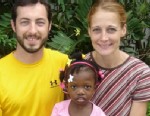
Wearing her special "adoption day" pin, Maya Esther headed Wednesday to a Marion County court in Knoxville, Iowa, for the final step in her adoption journey.

Meet Maya Carolyn Esther Poulter

"Just like a biological child grows in a mother's stomach, an adopted child grows in her mother's heart," Poulter said from the stand in court. "We are so blessed God chose her to be in our family."

With a final bang of the gavel, the adoption was official.

As many as 250,000 people are believed to have been killed as a result of the 7.0-magnitude quake.

Billions of dollars from around the world have been pledged to aid Haiti's recovery.

ABC News' Thea Trachtenberg and Lana Zak contributed to this report.

Adopt a North Korean (translated article)

Adopt a North Korean (translated article)

April 7, 2010 in Uncategorized

Tags: adopt, North Korea, refugee, stateless orphan

“U.S. Human Rights Organization Moving Forward with Adoptions of 3 Stateless North Korean Orphan Refugees”

by Noh Jeong-min, Washington

210 Million Reasons to Adopt

Where We Stand
210 Million Reasons to Adopt
Haiti's devastating quake reminds us that orphans matter to God.

Two years ago, a Christian couple from Chambersburg, Pennsylvania, fell in love with an abandoned toddler, born with a disability and living in an orphanage in rural Haiti. Already adoptive parents of a Liberian child, Katy and Josh Manges decided to adopt the toddler, Malachi, who has a treatable bone disorder.

Then the January 12 earthquake that crushed so much of Port-au-Prince, costing an estimated 230,000 lives, put the prayerful plans of the Manges family in limbo. It also laid bare before the world how badly orphans and vulnerable children may be treated when they get caught up in red tape, corruption, and political correctness.

For the Manges family, the outcome was success. In late February, Malachi arrived in Miami into the welcoming arms of his new family. Yet the adoption required two years of effort, delayed by local politics and requiring a personal signature from Haiti's prime minister. At the last minute, rioters at Port-au-Prince's airport derailed Malachi's departure, falsely alleging that he and other adoptees had phony paperwork.

This episode stands alongside another, the still-unfolding saga of the Idaho Baptists who were arrested on suspect charges of child trafficking. The latter may have a long-lasting chilling effect on inter-country adoption just when adoptive parents are needed more than ever. There are 210 million orphans worldwide, and adoptions to the U. S. have dropped 45 percent since 2004.

The greater problem isn't with potential adopting parents. It's with a system that is severely broken. Christian leaders and churches have much to offer in advocating for the reform of confusing adoption laws, stronger enforcement of international norms, and making adoption more affordable, more visible, and a more honored practice.

Jedd Medefind, president of the Christian Alliance for Orphans, recently told Christianity Today that immediately after Haiti's quake, many agencies fielded waves of calls from people with a strong impulse to take Haitian orphans into their homes. Rather than dismiss or belittle this impulse, Medefind encouraged them to consider the many ways of supporting the children, recognizing that adoption is a long and uncertain process. Family reunification, orphanages, extended family care, and child sponsorship all have a role to play in meeting the needs of vulnerable children in crisis or chronic need.

But Medefind is quick to note that powerful political and cultural barriers often make adoption an arduous process that takes too long and costs too much. "The reality is that there are thousands of children, before and after the earthquake, who are genuinely in need of parents," he says. "To the extent that parents can't be found, we should not relegate children to living on the streets or [in] orphanages. The political and cultural factors often become unspoken reasons why children are forced to remain in institutional care or on the streets, which is a profound tragedy."

The political and cultural barriers stem from warped ideas about what is in a poor child's best interest. It isn't in the best interest of abandoned children to grow up destitute and barely literate, regardless of the imagined cultural benefit of remaining in their home country. Haiti itself is a vivid example of injustice. The government tolerates a modern form of child slavery by allowing 225,000 children ages 6-14 to work as restavecs (unpaid, indentured domestics).

Adoption, domestic or inter-country, should not be looked down upon as inferior at best or as a last resort. The 150,000 South Korean orphans adopted worldwide (99,000 to the U.S.) since the 1950s testify well to the durable difference a loving adoptive family can make.

For Christians, the biblical basis for adoption bears repeating. The Book of James beckons every true follower of Christ to become involved in the lives of orphans (and widows). It's not for married couples only. Godly, never-married singles have successfully adopted, and most readily affirm the ideal that each child should live with a mother and father—whenever possible. So, Christian singles should not be automatically excluded from the pool of possibilities for adoption.

Adoption experts provided CT with four ways churches can increase their involvement:

  • give adoptive families space to tell their stories in church;
  • find ways to give small starter grants to people interested in adopting;
  • encourage the adoption of children with special needs; and
  • develop a full spectrum of responses, from child sponsorship to adoption.

CT recently talked with a never-married woman who adopted a young girl from Kazakhstan into her home (at a personal initial cost of $36,000). For her, the question was, "Are we talking about live souls?" Not mere "victims" or "political symbols" or "the needy," but children for whom Christ died, who need a home where the love of God is lived and shared with the least of these.


'Miracle' comes full circle with reunion of Haitian baby and parents

'Miracle' comes full circle with reunion of Haitian baby and parents

By Elizabeth Cohen, CNN Senior Medical Correspondent

April 6, 2010 -- Updated 1914 GMT (0314 HKT)

Nadine Devilme and Junior Alexis are all smiles after being reunited with their daughter, Jenny.

STORY HIGHLIGHTS

CIC not prioritizing adoption

CIC not prioritizing adoption

Tova Krause Grindlay, North Shore News

Published: Sunday, April 04, 2010

Dear Editor:

I am upset by a few aspects of your March 28 story Wrapped in Red Tape and Trapped in Africa with respect to Citizen and Immigration Canada's reaction to international adoption cases.

Preet Mandir initiates proposal for older orphans

Preet Mandir initiates proposal for older orphans

Most adoptive parents may prefer toddlers, but there are many older children between six and 18 years of age waiting to find a home.

To deal with this issue, the Balwant Kartar Anand Foundation's Preet Mandir childcare, adoption and family rehabilitation centre at Coyaji Road, Camp, has proposed to introduce the 'Godfather system'. Under this, a family can look after an orphan till he or she is adopted. The centre is planning to send its proposal to the government for approval.

Speaking to DNA, Preet Mandir's managing trustee JS Bhasin said following his visit to some government and private remand homes, he found that they do not have any plans for older orphans after 18 years of age.

?"They are left on their own. Such young adults with no formal education fall prey to unscrupulous elements. Without education or vocational training, they take to begging or join criminal gangs. Therefore, we have focused our attention on rehabilitation of older children," Bhasin said.

Bulgaria NOT Closing to Adoption

Bulgaria NOT Closing to Adoption

Rumors

April 01,2010 / Anonymous

Rumors of Bulgaria closing to international adoption are untrue. Bulgaria continues to iron-out its program to place orphaned children internationally. In a March 23rd forum between Bulgarian Ministry of Justice (MoJ) officials, the Social Support Agency in Bulgaria , and representatives of Non-Government Organizations, it was agreed by all to work more closely in sharing information about special needs and older children. It was also established that many more children will be added to the adoption registry during 2010, in the hope of allowing these children to find permanency.

Due to the intensity of the work needed to thoroughly document each child's case before adding the child to the registry, it was acknowledged that patience must be exerted by each agency and prospective family concerned with the welfare of these children. The process will require many months before all children living in orphanages have a clear, documented case plan.

Din Malta,cu dragoste:povestea unui copil adoptat

Mar?i, 23 Martie 2010. 3 comentarii, 2 voturi

Din Malta,cu dragoste:povestea unui copil adoptat

Autor: Oana Cr?ciun

Florentina tr?ie?te de 14 ani în Malta, la peste 1.300 de kilometri de ?ara natal? ?i de familia care a abandonat-o din cauza s?r?ciei. Vine îns? în România an de an.

1 /2.

Vittoria del Governo romeno sui bambini abbandonati

<<>

Data: 29-03-10

Vittoria del Governo romeno sui bambini abbandonati

“Siamo un gruppo di ragazzi che hanno vissuto negli orfanotrofi di Brasov, in Romania. Vogliamo raccontarvi del nostro passato ma prima di tutto ringraziarvi per la petizione sulla riapertura delle adozioni internazionali in Romania. Abbiamo sofferto molto tra le mura di quegli istituti dove botte e abusi erano all’ordine del giorno. Molti di noi avrebbero potuto essere adottati, molti di noi si sarebbero potuti salvare ma il Governo rumeno non ci ha mai consentito di avere una famiglia. Dopo avere compiuto 18 anni, ciascuno di noi ha dovuto lasciare l’orfanotrofio. Ci siamo ritrovati soli, a vivere in strada. Questo succederà anche a tutti i minori della Romania se l’adozione internazionale non sarà aperta.”

Questa la lettera ricevuta qualche giorno dopo la chiusura della Petizione attraverso cui Ai.Bi. chiedeva al Parlamento Europeo la riapertura delle Adozioni Internazionali in Romania.